
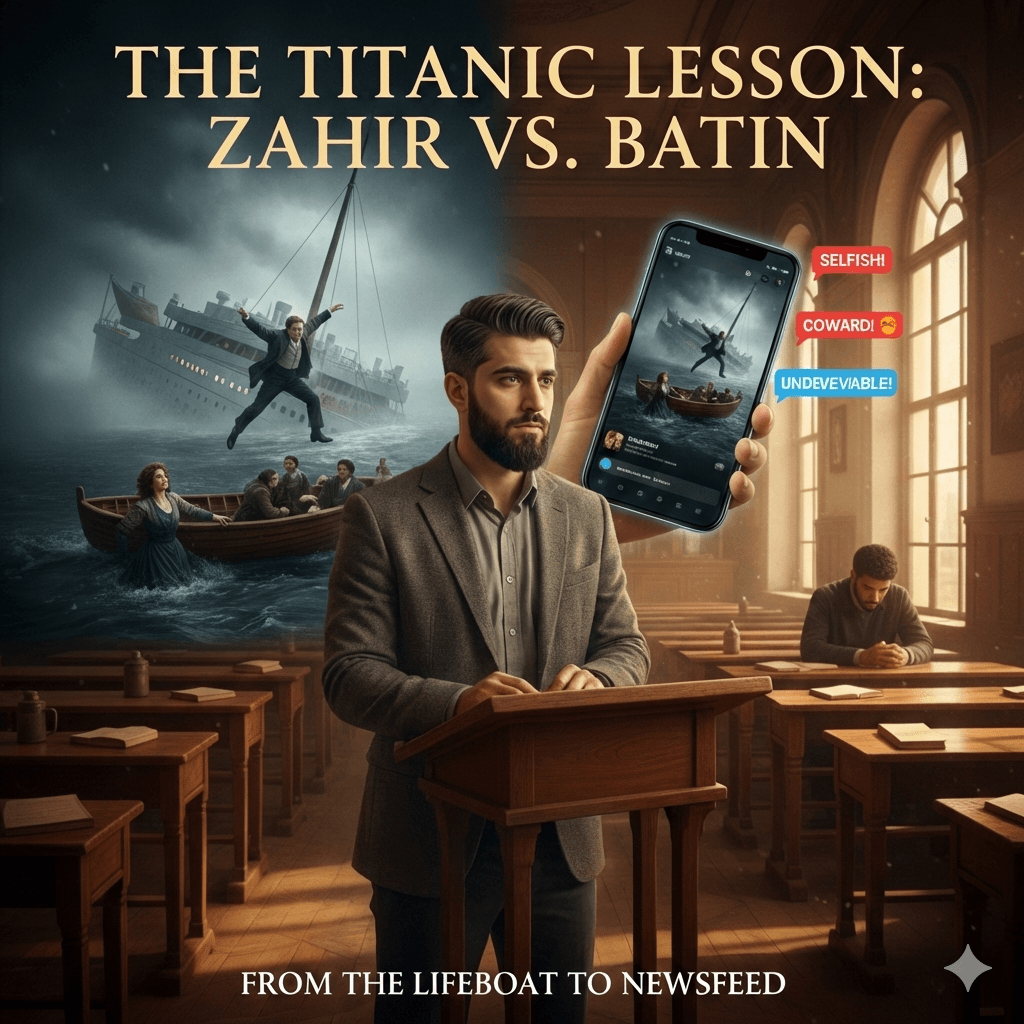


The Setup: Cairo University, A Classroom, A Question
(Professor Yasser’s classroom, Cairo University, just after Dhuhr prayer. The scent of oud and old paper lingers in the sun-warmed air.)
Professor Yasser adjusted his kufi, waiting for the rustling to settle. His “Islamic Ethics (Ilm Al-Akhlaq)” class was full of bright faces, young men and women in neat hijabs and modest collars, notebooks open, pens poised. They were thinkers, debaters, eager to dissect the world with the sharp tools of faith and reason.
“As-salamu alaikum wa rahmatullahi wa barakatuh (“May the peace, mercy, and blessings of Allah be with you”),” he began, his voice warm.
“Wa alaykumus-salam wa rahmatullahi wa barakatuh (“And upon you be the peace, mercy, and blessings of Allah”),” the class chorused back.
“Today,” he said, leaning on the lectern, “we discuss a gap. The gap between Zahir and Batin. The outer appearance and the inner reality. Our deen warns us against Gheebah—backbiting—and Su’ al-Dhann—ill thought—for this very reason. But our human nature… our nature is quick to judge. Let us test this.”
He had their attention. The Quranic references shifted the topic from academic to spiritual.

The Titanic Parable: A Test of Judgment
“Imagine this,” Professor Yasser said, his gaze sweeping the room. “It is 1912. The great ship Titanic is wounded, dying in the icy North Atlantic. In the chaos, amidst the cries of ‘Allahu Akbar’ and prayers for mercy, a Muslim husband and wife find themselves at the railing. By the will of Allah, they reach a lifeboat.”
He painted the scene with quiet words: the screaming, the tilting deck, the unforgiving sea.
“But there is a problem. One seat. Only one. The boat is almost full. In that final, terrible moment, the husband uses his last strength to heave himself into the spot. The wife is left in the water, her frozen fingers slipping from the wood.

The people in the boat—aged matrons, married women, young ladies, and children—wore expressions of dismal judgment as they watched a husband abandon his wife to the icy sea, while their own men had chosen to stay behind.
Women of all ages murmured among themselves: How selfish is that husband? Has he no shame, leaving his poor wife to die? He is a blot on humanity.
Even a murmur of discomfort rippled through the classroom. Eyes narrowed. A few students shook their heads.
“Just before the water takes her,” Professor Yasser continued, his tone grave, “she calls out to him. Her last words. What do you think she said?”

The Verdict of the Lifeboat—Zahir on Full Display
The classroom, so disciplined a moment before, erupted with passionate judgment.
“Hypocrite!” hissed a young man with a carefully trimmed beard, his face flushed with anger.
“He abandoned his amanah!” a sister in a blue hijab declared, referring to the sacred trust of marriage. “His fear overcame his faith!”
“How could he face Allah?” another added, the verdict swift and severe. The responses were sharp, fueled by a sense of religious betrayal. They saw a man failing in his duty, choosing his nafs—his lower self—over his wife.

Professor Yasser listened, his expression a calm mask, just as the Quran advises: And be patient, for indeed, Allah is with the patient. His eyes, however, drifted to the back. There, by the window overlooking the garden, sat Khalid. A quiet boy who always came early and left late. His head was bowed, not in prayer, but as if carrying a weight. He was tracing the pattern of the wood grain on his desk with a single finger.
When “Dir Balak ‘al-Bint” Becomes a Sujud Moment
“Khalid?” Professor Yasser’s voice softened, cutting through the noise. “You are silent, my son. What is in your heart? What do you think she said?”
The room went quiet, turning to look. Khalid did not raise his head. When he spoke, his voice was a threadbare whisper, but it carried in the sudden stillness.
“Dir balak ‘al-bint (دير بالك على البنت).’”
(Look after the daughter.)
The Arabic phrase hung in the air, simple and devastating. It wasn’t a curse. It was a reminder of a deeper amanah.
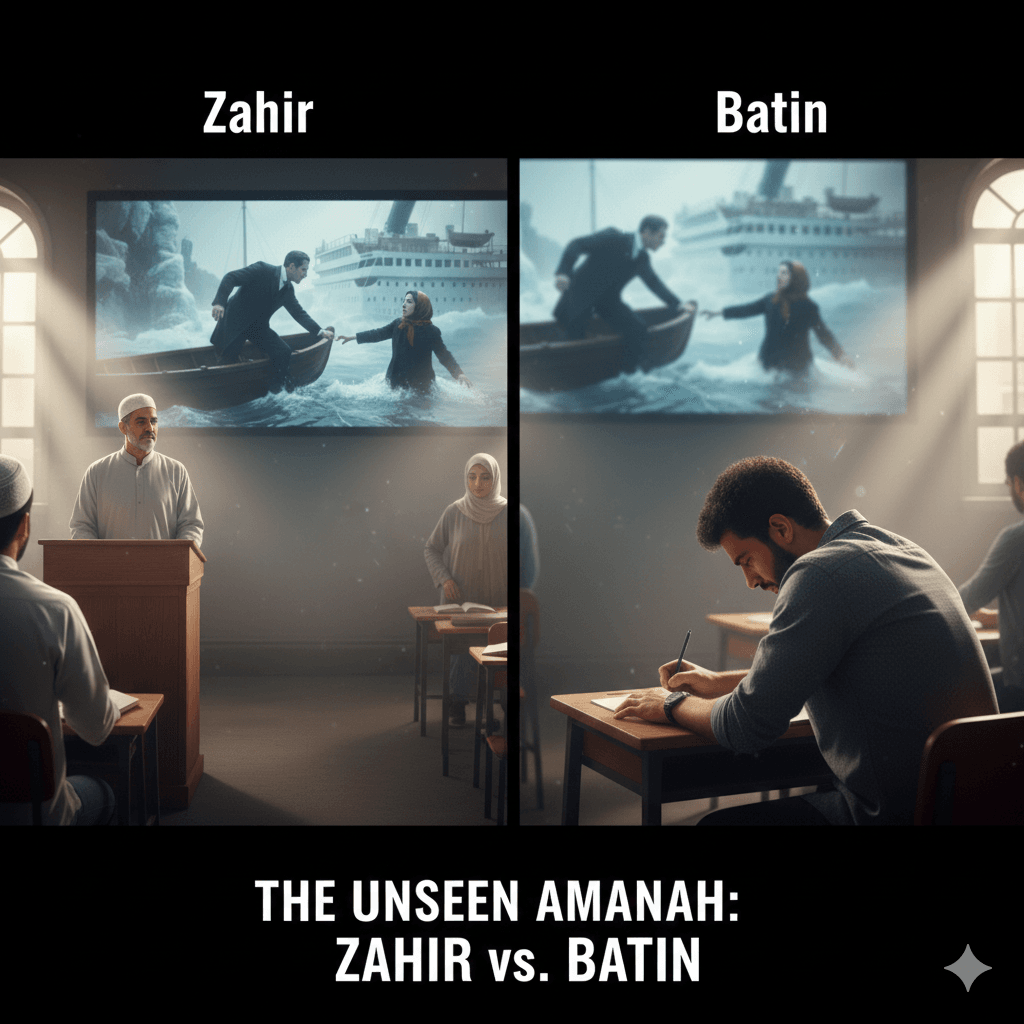
Khalid’s Silent Wisdom
Professor Yasser felt his own breath catch. He placed a steadying hand on the cool wood of the lectern. “You have heard this parable before?” he asked gently.
Khalid finally looked up. His eyes were not angry, but held a profound, weary sorrow that seemed too old for his young face. “No, Professor,” he whispered. “But… when my mother was in the hospital, before the cancer took her, she held my father’s hand and said those same words. ‘Take care of Khalid.’”
A silence descended, deeper and more profound than before. It was the silence of Sujud—of total submission to a truth greater than oneself. The sister in the blue hijab brought a hand to her mouth. The bearded young man looked down, chastened.
Professor Yasser turned fully towards the window, blinking rapidly, watching the leaves tremble in the breeze. He gave them all, and himself, a long moment. When he turned back, his eyes were glistening, but his voice was firm.
“Yes,” he said, the word heavy with conviction. “That is exactly what she said.”
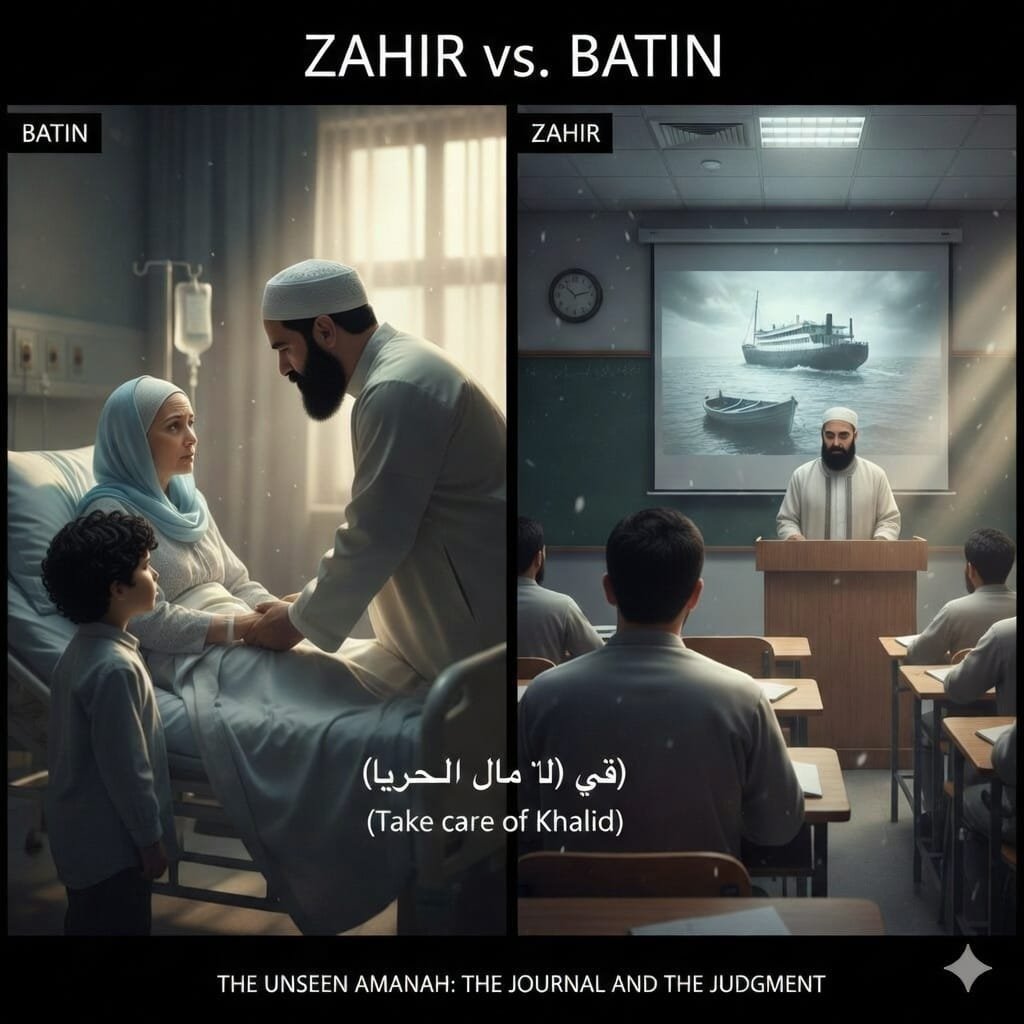
The Journal and the Judgment
He then finished the story he had prepared, but now every word was infused with the gravity of Khalid’s truth. The boat sailed away. The man returned, a ghost in his own community, bearing sidelong glances and whispered judgments for the rest of his life. He raised his daughter alone, a constant, silent testament to a promise made in freezing water.
“Years passed,” Yasser continued. “After the father’s death, his daughter found his journal.” He described the worn leather, the scent of sandalwood ink. He read the final entry, translating it into Arabic for their hearts to feel:
“My Yusra was already dying. The doctors in Great Britain had given their verdict, but, seeing my desperation to save Yusra, advised me—though with little hope—to visit doctors in New York. We undertook this voyage as our final Rihlah, our last journey together in this Dunya. I begged her to let me stay. I wished to die in her place. But she said, ‘If you stay, our Zara becomes an orphan in this world and the next. Your obligation now is to live. To be her anchor. Go. Obey me in this.’ My choice was not to save myself. It was to obey my wife’s final wasiyyah, her final instruction, and to fulfill my duty to our child. I left my heart with her in the deep, entrusting my soul to the Mercy of Al-Rahman.”
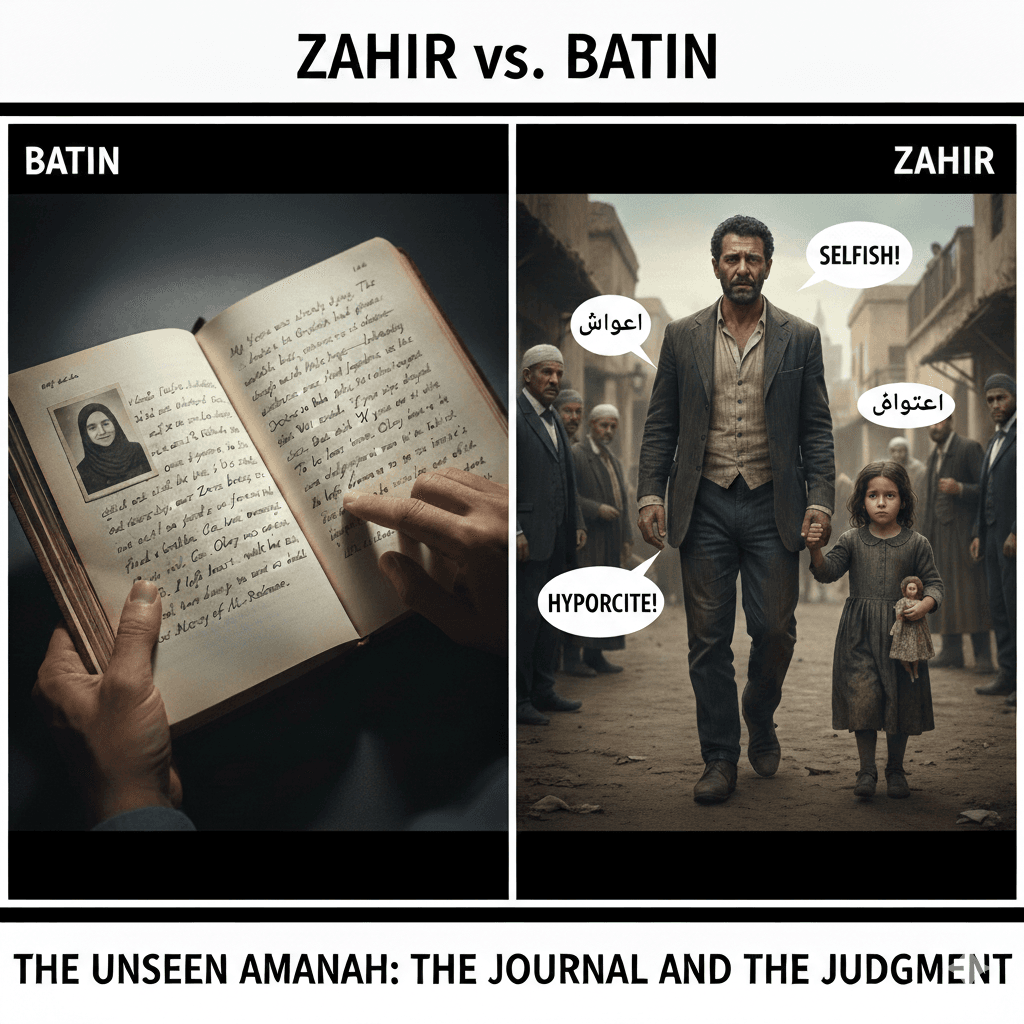
Unraveling the Truth: Understanding Batin and Zahir
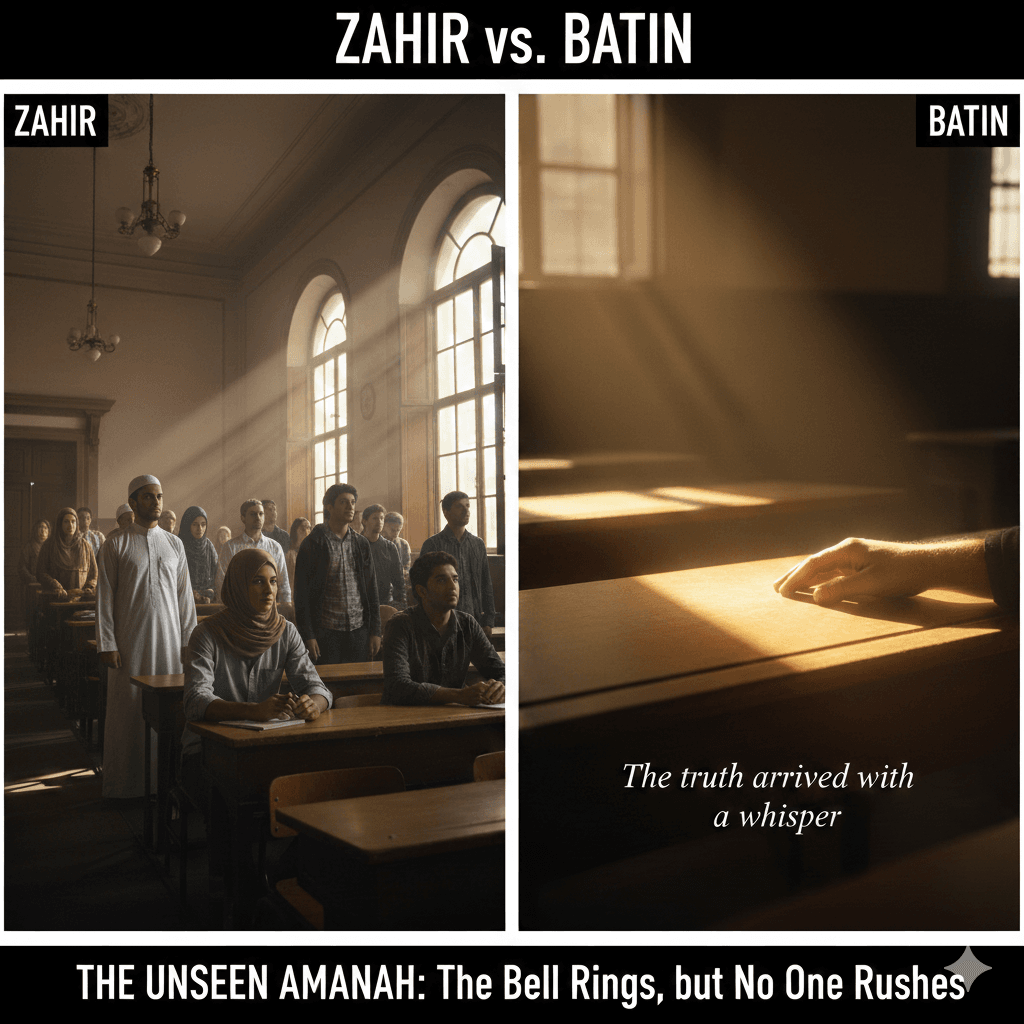
The classroom was utterly still. The earlier judgments lay shattered, replaced by a humbled, aching understanding. They had seen only the Zahir—the man jumping into the boat. They had been blind to the Batin—the ocean of faith, sacrifice, and painful obedience that lay beneath.
Professor Yasser closed the journal in his hands, a symbolic gesture.
“What you have learned today,” he said, his voice thick with emotion, “you would not learn from a thousand lectures. Our beloved Prophet, peace be upon him, said: ‘Beware of suspicion, for suspicion is the worst of false tales.’ We are so quick to judge someone’s actions without knowing the real motive behind them.”

He let his gaze rest on Khalid, who gave a slow, almost imperceptible nod of shared understanding.
“Because,” Professor Yasser concluded, “the truest stories—the stories of love, sacrifice, and ultimate tawakkul—are often the ones whispered not to the crowd, but to the cold sea, to the hospital quiet, or to Allah alone. And He is the best of Judges.”

The Bell Rings, but No One Rushes
The bell for the next lecture sounded—the deep, resonant chime of the Giza clock tower—its call a gentle reminder. No one rushed. The students gathered their things slowly, thoughtfully, their eyes avoiding each other’s in a new kind of respect. As they filed out of the hall, many glanced at Khalid—not with pity, but with a silent, profound Salaam.
Professor Yasser remained, gathering his papers. He looked at the empty desk in the back, then out at the garden, where the late afternoon sun dappled the path. He whispered a prayer of gratitude, not just for the lesson taught, but for the one received. The truth, he reflected, often arrived not with a shout, but with a whisper from the back row, carrying the weight of a mother’s last, loving command.
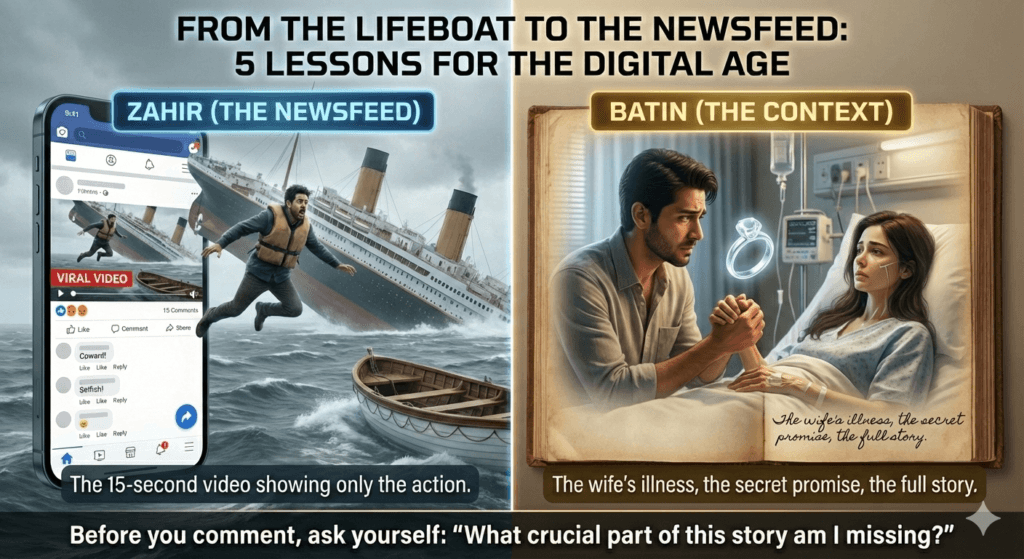
From the Lifeboat to the Newsfeed: 5 Lessons for the Digital Age
Social Media is the Ultimate Test of Zahir vs. Batin:
It shows you the action (the man jumping into the boat) but almost never shows you the context (the wife’s illness, the secret promise). Before you comment, react, or share an opinion, ask yourself: “What crucial part of this story am I missing?” The whole truth is rarely in the 15-second video.
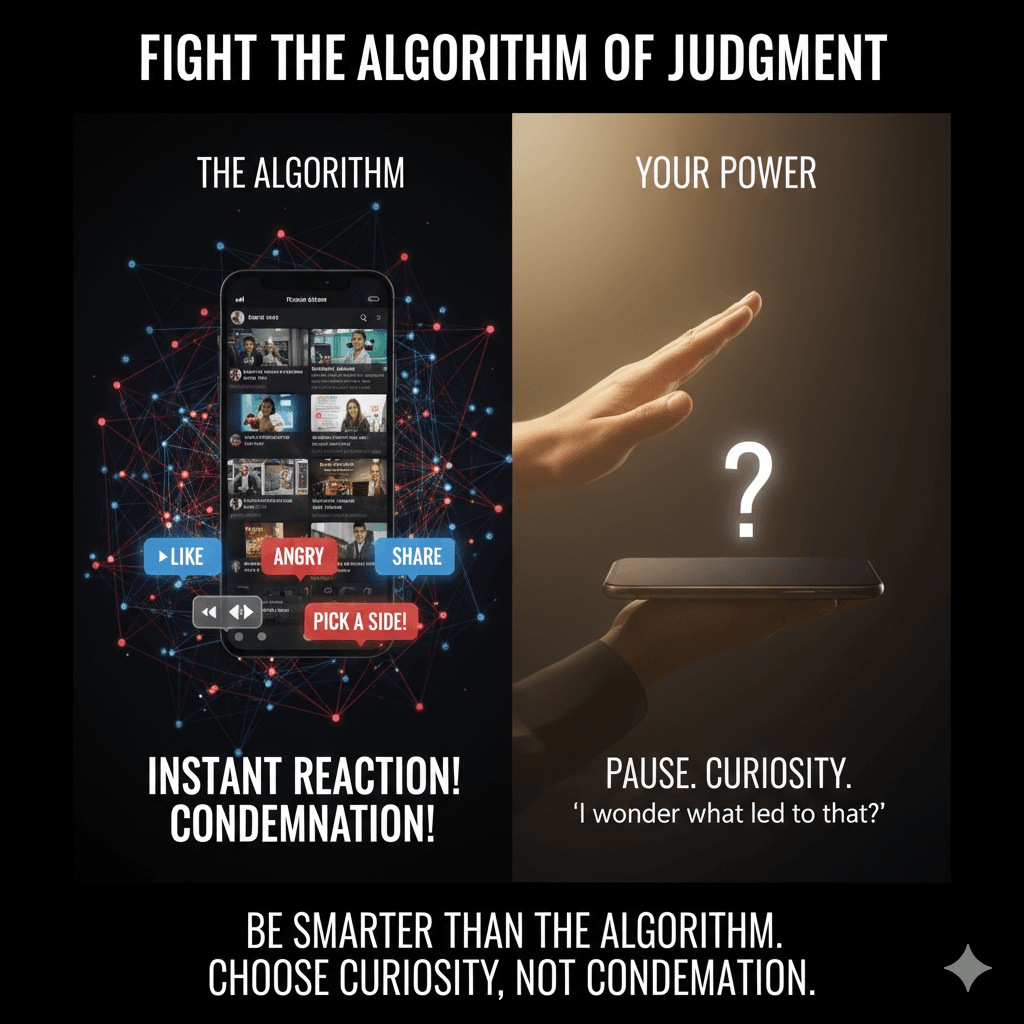
Fight the Algorithm of Judgment:
Social media rewards quick, emotional reactions. It pushes you to pick a side instantly. Be smarter than the algorithm. Pause your scroll, pause your judgment. Let your first reaction be curiosity, not condemnation. “I wonder what led to that?” is a more powerful and godly question than “I can’t believe they did that!”
Your Quietest Friend Might Hold the Real Answer:
In the story, the truth came from Khalid, the quiet one in the back, not the loudest voices. Online, the truest perspectives often aren’t the viral hot takes. They’re in the DMs, the thoughtful comments, the stories shared in trust. Value depth over decibels.

Protect Your Heart from Gheebah (Backbiting) in Digital Form:
Gossiping about someone in a group chat, mocking someone in comment sections, sharing a story to judge someone—this is the 21st-century version of backbiting. The sin is the same. The Prophet ﷺ warned us against suspicion because it poisons the heart. Let your digital footprint be clean of ill thoughts about others.

Be the Author of Compassion, Not the Critic:
Everyone is fighting a battle you know nothing about—a sick parent, a hidden anxiety, a private dua. The man in the boat carried a burden no one saw. Choose to be the one who gives the benefit of the doubt, who sends a kind DM instead of a shady comment, who remembers that only Allah ﷻ is the True Judge.

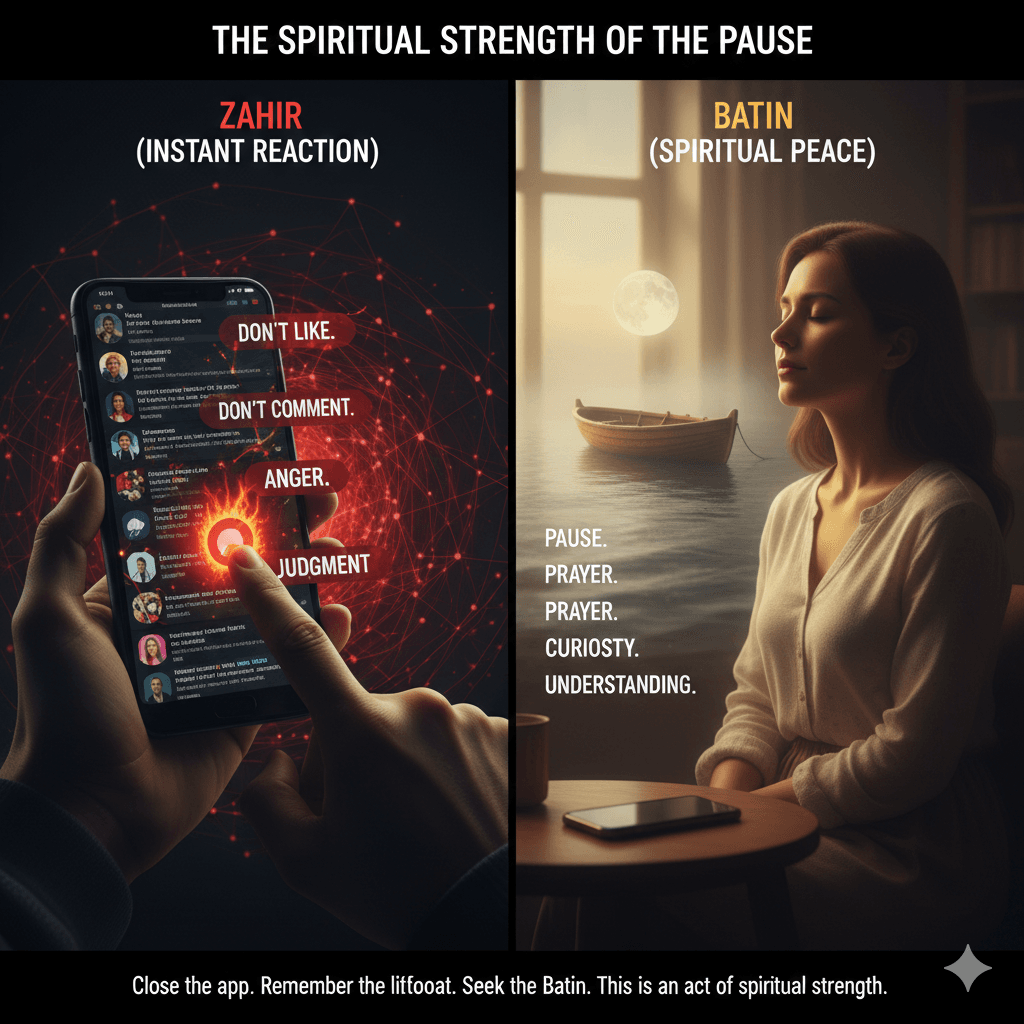
Challenge: Next time you see something online that makes you instantly angry or judgmental, stop. Don’t like, don’t comment. Just close the app for a minute. Remember the lifeboat. Ask Allah to help you see the Batin, the unseen reality. That moment of pause is an act of spiritual strength.
- 14 Best Panchatantra stories in hindi
- 15 Best Children Stories in English from Panchatantra 2.0
- 16 Best Aesop's Fables in Hindi with moral lessons
- 17 Best Aesop's Fables with moral lessons for children
- Arabian Nights
- Author's Best Written Stories in English
- Author's Best Written Stories in Hindi
- Baital Pachisi बैताल पचीसी in Hindi
- Bedtime Stories for All
- Hindi Love Stories
- Love and Romance
- Vikram and Betal series: Riddle Solving Stories
You can join my WhatsApp Channel by clicking the link here

