
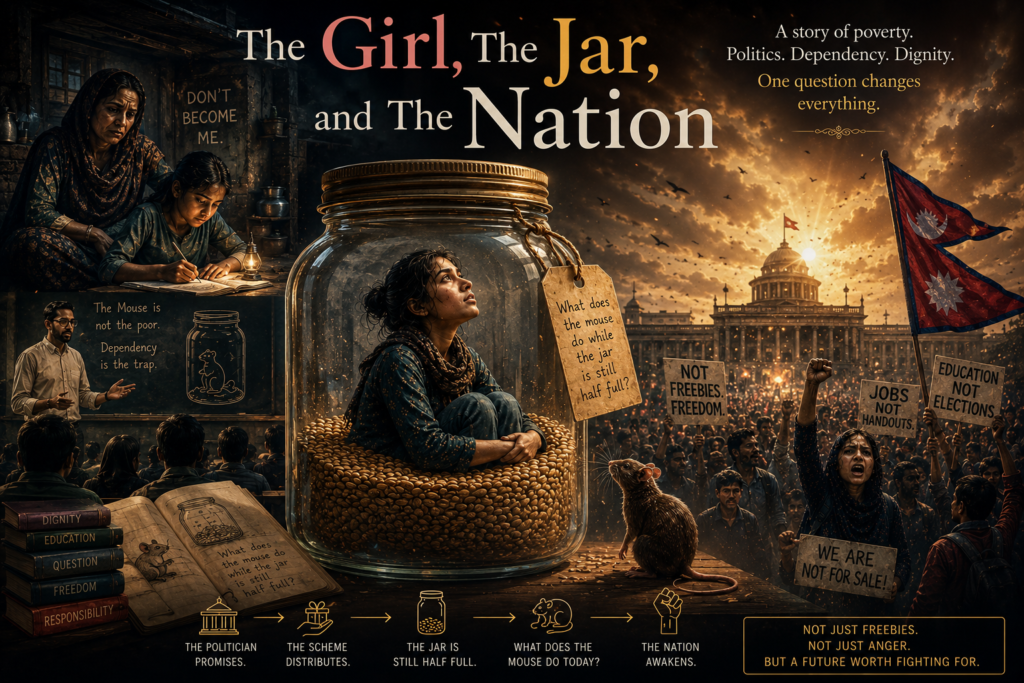

Hunger Before Class
Zahira had started skipping breakfast two weeks ago. Not because there was no food at home—her mother always managed something, even if it was just leftover roti with salt—but because the thirty-rupee bus fare to Imaan University mattered more than hunger. Her scholarship covered tuition. It covered nothing else.
She arrived early that morning, earlier than usual, because the alternative was sitting in her rented room near the bus stand, listening to her roommate Sadiqa’s mother on speakerphone, discussing which government scheme they’d signed up for this month. The conversations all sounded the same. A new one had been announced. Free cooking gas cylinders. Sadiqa’s mother was thrilled.
Zahira sat in the third row of the history faculty’s lecture hall and pulled out her notebook. The hall filled gradually—Yahya from the philosophy department, Maqsood who always sat in the back and argued with everyone, Sumaiya who wrote poetry in the margins of her civics textbook. Then Nomaan slipped in beside Zahira, slightly out of breath.
“You hear?” he whispered. “Professor Yasser is doing Civics today. Not history.”
“So?”
“So last time he did Civics, three students walked out.”
“Good. More space.”
Nomaan grinned but didn’t push it. He knew Zahira’s moods the way one knows weather—by the shift in pressure before anything visible happens.
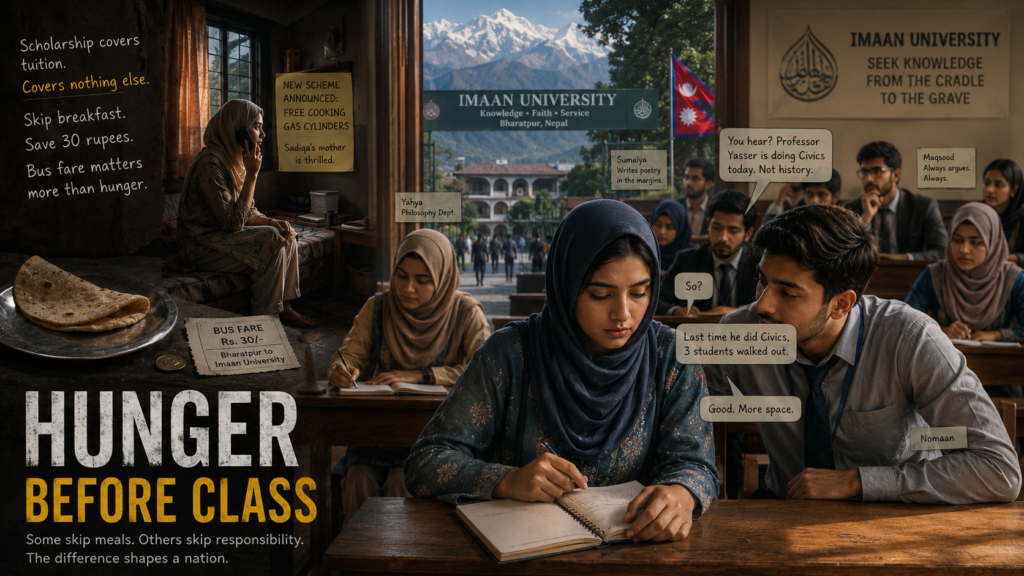
The Professor Who Never Needed Notes
Professor Yasser entered at exactly nine o’clock. Kurta crisp, beard trimmed, wire-rimmed glasses catching the light from the tall windows. He carried nothing but a single piece of chalk. Zahira had noticed this about him before—he never brought notes, never used the projector unless something visual was unavoidable. He treated the blackboard like a canvas he wasn’t sure he deserved.
“Assalamu’alaikum warahmatullahi wabarakatuh,” he said.
The response rolled back. Then silence.
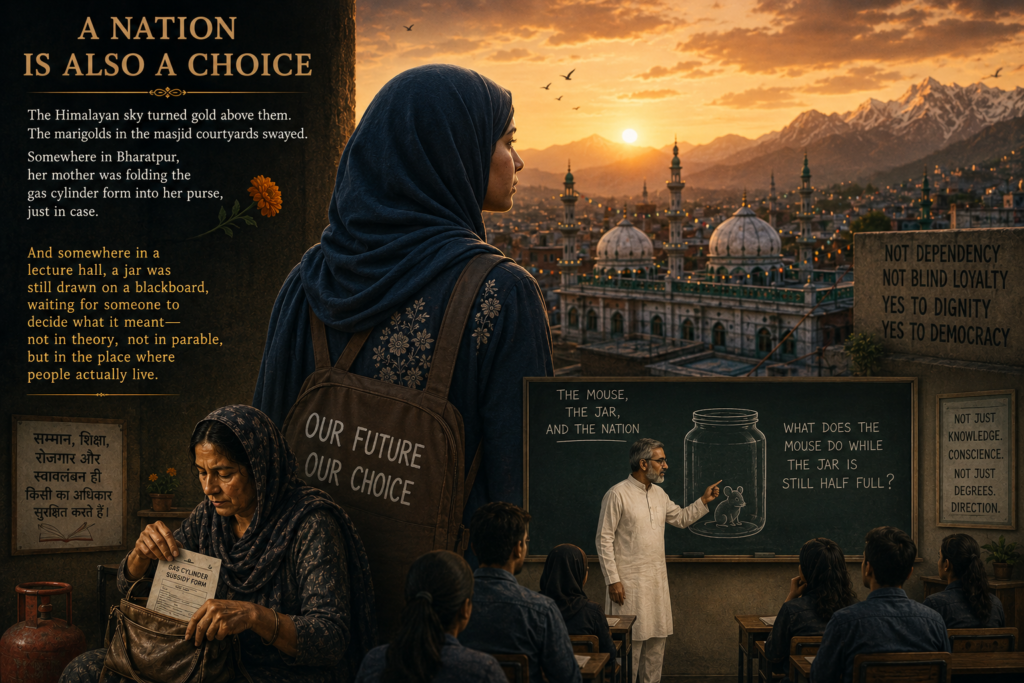
He drew two jars on the board. In the first, a small figure at the top, surrounded by grain. In the second, the same figure at the bottom, the jar nearly empty.
“A mouse in a jar,” he said. “Tell me what you see.”
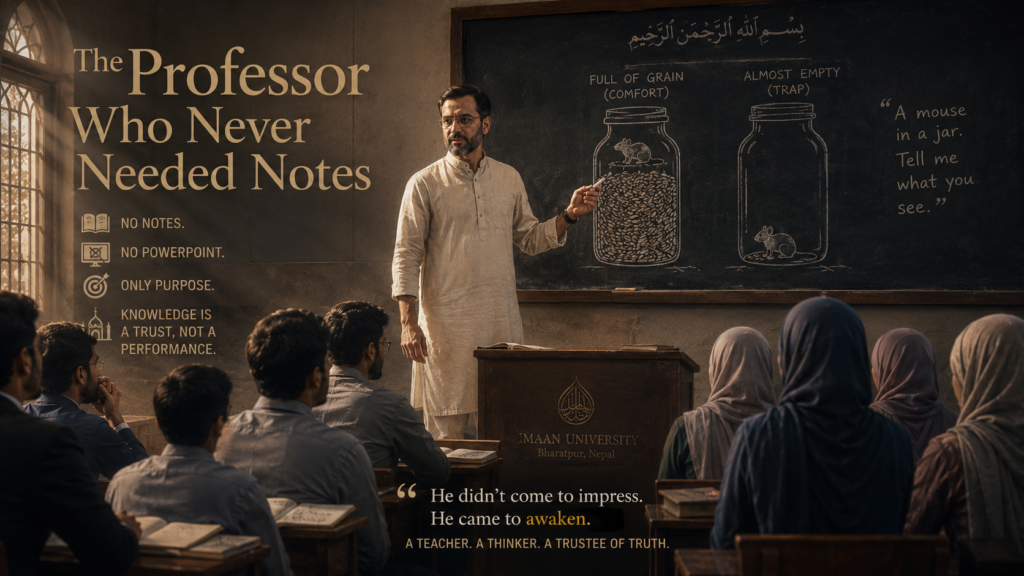
A Mouse in a Jar
Sadiqa, who had materialized in the back row without Zahira noticing, called out: “A mouse living his best life.”
Laughter. Yasser smiled briefly.
“And the second?”
Yahya, from the philosophy department, said something about divine provision. Maqsood, from the back, muttered that wishful thinking was a disease. The room started to buzz—everyone seeing something different, projecting something personal.
Professor Yasser let it go on for a full minute. Then he raised the chalk and tapped it against the board. The sound was small, but the room quieted.
The Comfort Trap
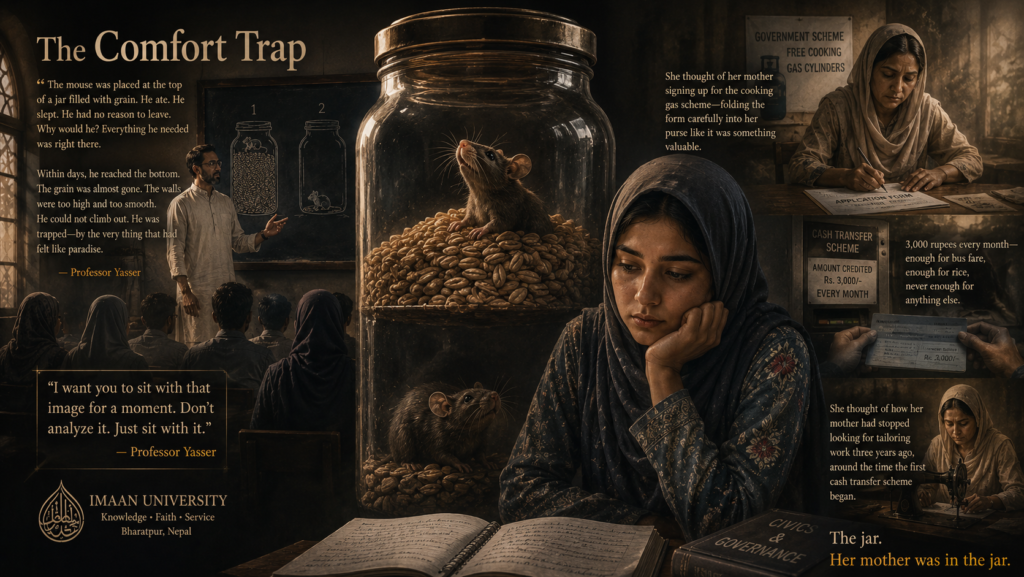
“The mouse was placed at the top of a jar filled with grain. He ate. He slept. He had no reason to leave. Why would he? Everything he needed was right there.” Professor Yasser set the chalk down. “Within days, he reached the bottom. The grain was almost gone. The walls were too high and too smooth. He could not climb out. He was trapped—by the very thing that had felt like paradise.”
He turned from the board. “I want you to sit with that image for a moment. Don’t analyze it. Just sit with it.”
Zahira sat with it. The problem wasn’t the image—it was too clear, too familiar. She thought of her mother signing up for the cooking gas scheme last week, the way she’d folded the form carefully into her purse like it was something valuable. She thought of the 3,000 rupees that arrived every month into her mother’s bank account—enough for bus fare, enough for rice, never enough for anything else. She thought of how her mother had stopped looking for tailoring work three years ago, around the same time the first cash transfer scheme began.
The jar. Her mother was in the jar.
When the Jar Looks Like Home
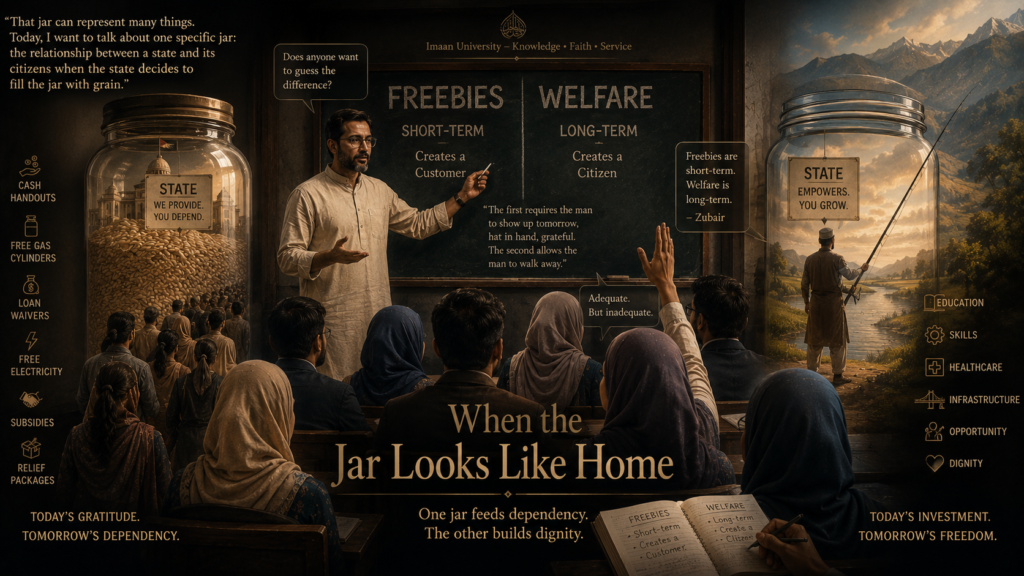
“The parable is not subtle,” Professor Yasser continued. “That jar can represent many things. Today, I want to talk about one specific jar: the relationship between a state and its citizens when the state decides to fill the jar with grain.”
He wrote two words on the board: FREEBIES and WELFARE.
“Does anyone want to guess the difference?”
Zubair, who always did the reading, raised his hand. “Freebies are short-term. Welfare is long-term.”
“Adequate. But inadequate.” Professor Yasser drew a line between the words. “Give a man a fish every day, and you have created a customer. Give a man a fishing rod and teach him to fish, and you have created a citizen. The first is a freebie. The second is welfare. The first requires the man to show up tomorrow, hat in hand, grateful. The second allows the man to walk away.”
The Price of Easy Money
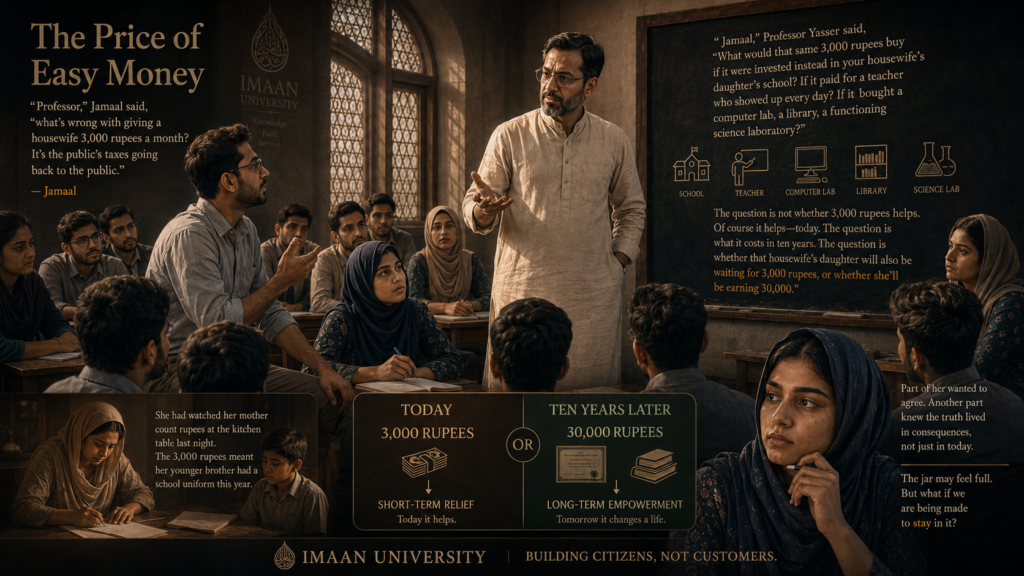
“Professor,” Jamaal said from the left side, “what’s wrong with giving a housewife 3,000 rupees a month? It’s the public’s taxes going back to the public.”
Zahira’s pen stopped. She looked at Jamaal—he was one of those students whose father owned a hardware store in Narayanghat. His arguments were always clean because he’d never had to live inside them.
“Jamaal,” Professor Yasser said, and something in his tone made Zahira look up. It wasn’t impatience. It was something more careful. “What would that same 3,000 rupees buy if it were invested instead in your housewife’s daughter’s school? If it paid for a teacher who showed up every day? If it bought a computer lab, a library, a functioning science laboratory?”
Jamaal opened his mouth, then closed it.
“The question is not whether 3,000 rupees helps. Of course it helps—today. The question is what it costs in ten years. The question is whether that housewife’s daughter will also be waiting for 3,000 rupees, or whether she’ll be earning 30,000.”
Zahira wanted to agree. She did agree, in the part of her mind that wrote scholarship essays and aced civics exams. But another part of her—the part that had watched her mother count rupees at the kitchen table last night, the part that knew the 3,000 rupees meant her younger brother had a school uniform this year—that part sat quietly and said nothing.
The Mathematics of Dependency
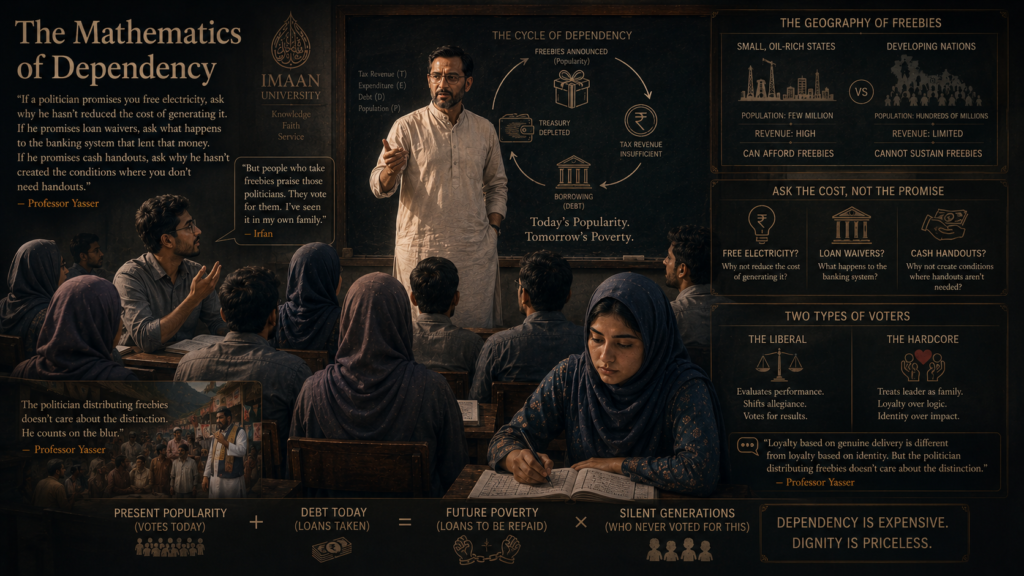
The lecture moved through the geography of freebies—how tiny, oil-rich Gulf states could afford what developing nations with populations in the hundreds of millions could not. Professor Yasser spoke about the mathematics: taxes collected, treasuries depleted, borrowing from future generations to fund present popularity.
“If a politician promises you free electricity, ask why he hasn’t reduced the cost of generating it. If he promises loan waivers, ask what happens to the banking system that lent that money. If he promises cash handouts, ask why he hasn’t created the conditions where you don’t need handouts.”
Irfan, sitting near the window, said something that made the room shift. “But people who take freebies praise those politicians. They vote for them. I’ve seen it in my own neighborhood.”
Professor Yasser was quiet for a moment. Longer than usual.
“Yes,” he said. “You have. So have I.”
He didn’t elaborate. He moved on to the two types of voters—the liberal who evaluated performance and shifted allegiance, and the hardcore who treated their leader as family. Maqsood interrupted to say this was oversimplified, that loyalty wasn’t always blind, that sometimes it was based on real historical grievance. Professor Yasser considered this.
“You’re right,” he said. “Loyalty based on genuine delivery is different from loyalty based on identity. But I’d argue that the politician distributing freebies doesn’t care about the distinction. He counts on the blur.”
“Let Them Get Used to Free Food”
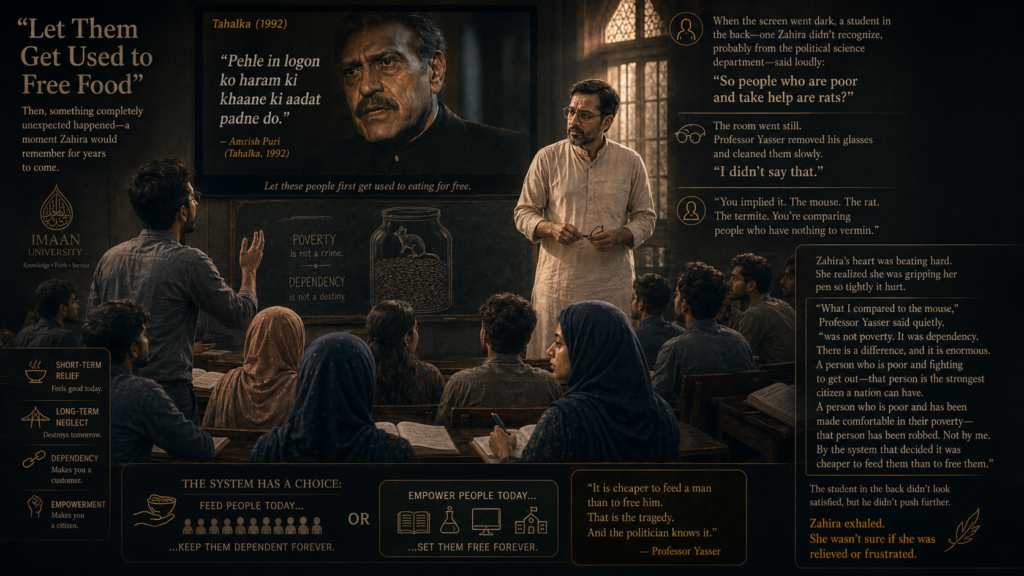
Then, something completely unexpected happened—a moment Zahira would remember for years to come.
Professor Yasser played a clip from an old Hindi film—Tahalka, 1992. Amrish Puri’s voice filled the room: “Pehle in logon ko haram ki khaane ki aadat padne do.” Let these people first get used to eating for free.
When the screen went dark, a student in the back—one Zahira didn’t recognize, probably from the political science department—said loudly: “So people who are poor and take help are rats?”
The room went still.
Professor Yasser removed his glasses and cleaned them slowly. “I didn’t say that.”
“You implied it. The mouse. The rat. The cockroach. You’re comparing people who have nothing to vermin.”
Zahira’s heart was beating hard. She realized she was gripping her pen so tightly it hurt.
“What I compared to the mouse,” Professor Yasser said quietly, “was not poverty. It was dependency. There is a difference, and it is enormous. A person who is poor and fighting to get out—that person is the strongest citizen a nation can have. A person who is poor and has been made comfortable in their poverty—that person has been robbed. Not by me. By the system that decided it was cheaper to feed them than to free them.”
The student in the back didn’t look satisfied, but he didn’t push further.
Zahira exhaled. She wasn’t sure if she was relieved or frustrated.
The Corridor Argument
After the lecture, students milled in the corridor. Nomaan fell into step beside her.
“Tough lecture,” he said.
“It was a good lecture.”
“Was it?”
She stopped walking. “What do you mean?”
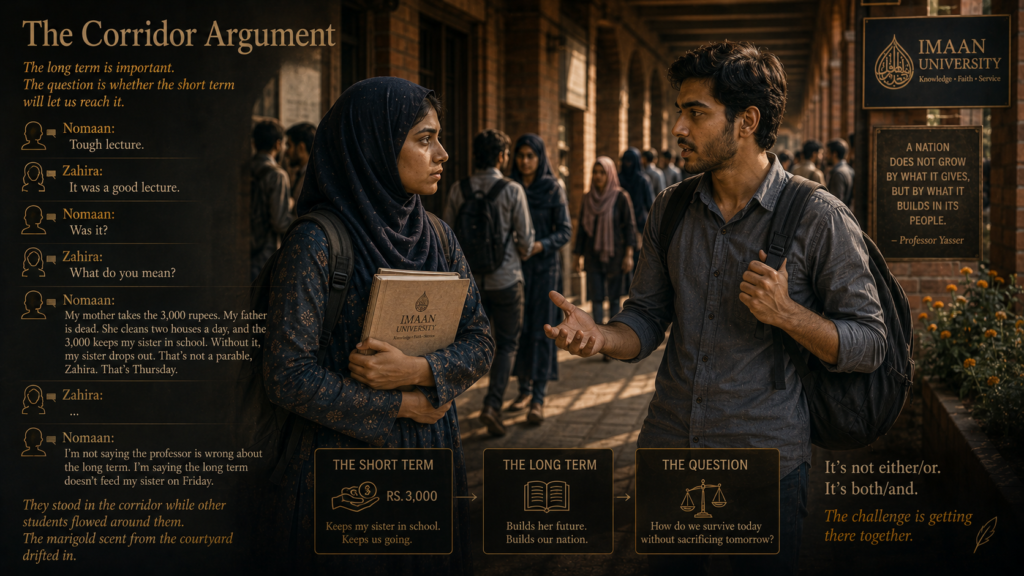
Nomaan shifted his bag from one shoulder to the other. “My mother takes the 3,000 rupees. My father is dead. She cleans two houses a day, and the 3,000 keeps my sister in school. Without it, my sister drops out. That’s not a parable, Zahira. That’s Thursday.”
Zahira said nothing.
“I’m not saying the professor is wrong about the long term. I’m saying the long term doesn’t feed my sister on Friday.”
They stood in the corridor while other students flowed around them. The marigold scent from the courtyard drifted in.
What Theory Sounds Like to the Poor
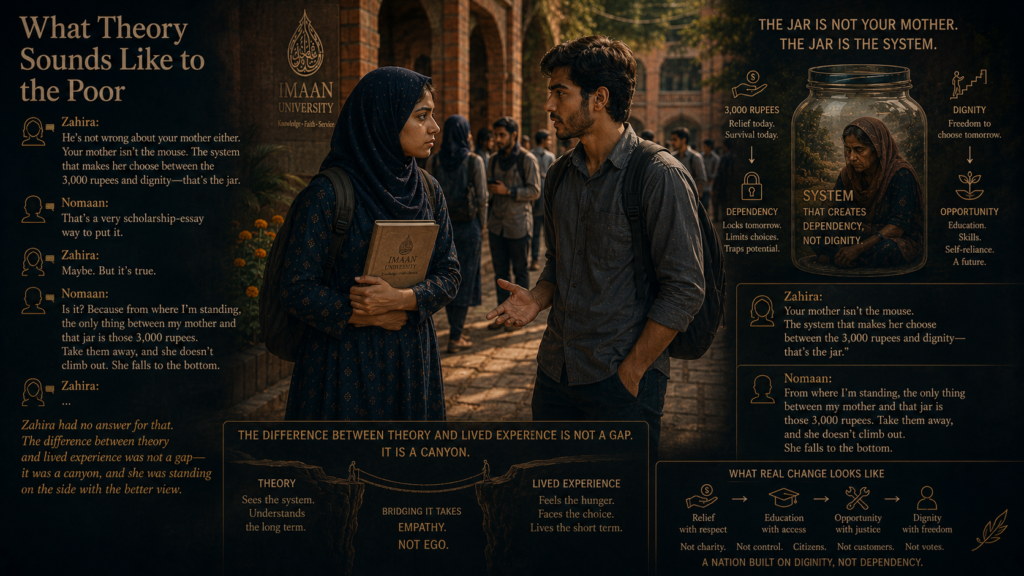
“He’s not wrong about your mother either,” Zahira said carefully. “Your mother isn’t the mouse. The system that makes her choose between the 3,000 rupees and dignity—that’s the jar.”
Nomaan stared at her. “That’s a very scholarship-essay way to put it.”
“Maybe. But it’s true.”
“Is it? Because from where I’m standing, the only thing between my mother and that jar is those 3,000 rupees. Take them away, and she doesn’t climb out. She falls to the bottom.”
Zahira had no answer for that. The difference between theory and lived experience was not a gap—it was a canyon, and she was standing on the side with the better view.
“When You’re Drowning, You Grab the Rope”
That evening, she called her mother.
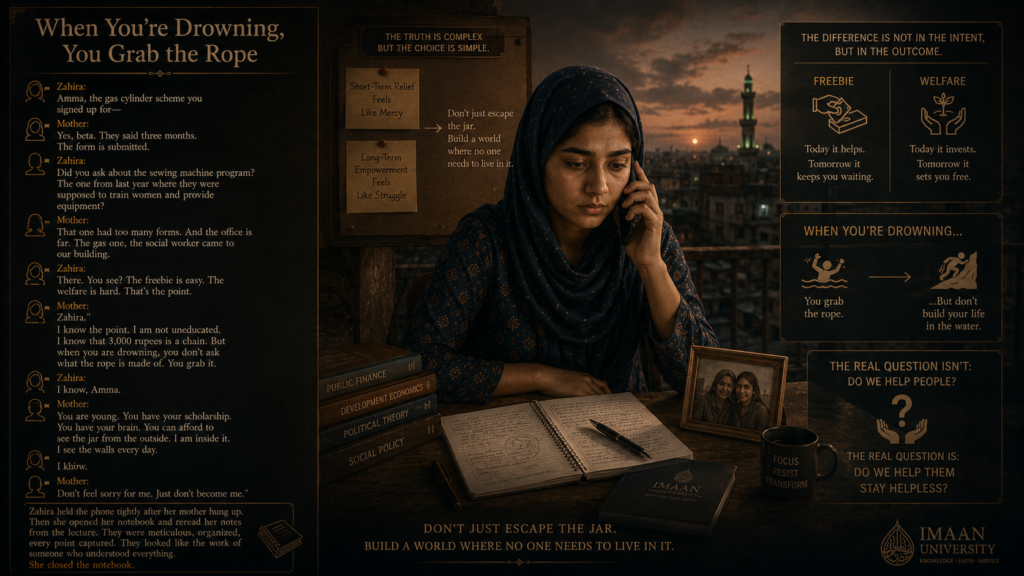
“Amma, the gas cylinder scheme you signed up for—”
“Yes, beta. They said three months. The form is submitted.”
“Did you ask about the sewing machine program? The one from last year where they were supposed to train women and provide equipment?”
A pause. “That one had too many forms. And the office is far. The gas one, the social worker came to our building.”
“There. You see? The freebie is easy. The welfare is hard. That’s the point.”
Another pause. Longer this time.
“Zahira.” Her mother’s voice was tired but not unkind. “I know the point. I am not uneducated. I know that 3,000 rupees is a chain. But when you are drowning, you don’t ask what the rope is made of. You grab it.”
Zahira closed her eyes. The evening call to prayer was sounding somewhere in the distance, over the rooftops of Bharatpur.
“I know, Amma.”
“You are young. You have your scholarship. You have your brain. You can afford to see the jar from the outside. I am inside it. I see the walls every day.”
“I know.”
“Don’t feel sorry for me. Just don’t become me.”
Zahira held the phone tightly after her mother hung up. Then she opened her notebook and reread her notes from the lecture. They were meticulous, organized, every point captured. They looked like the work of someone who understood everything.
She closed the notebook.
The Promise That Never Arrived
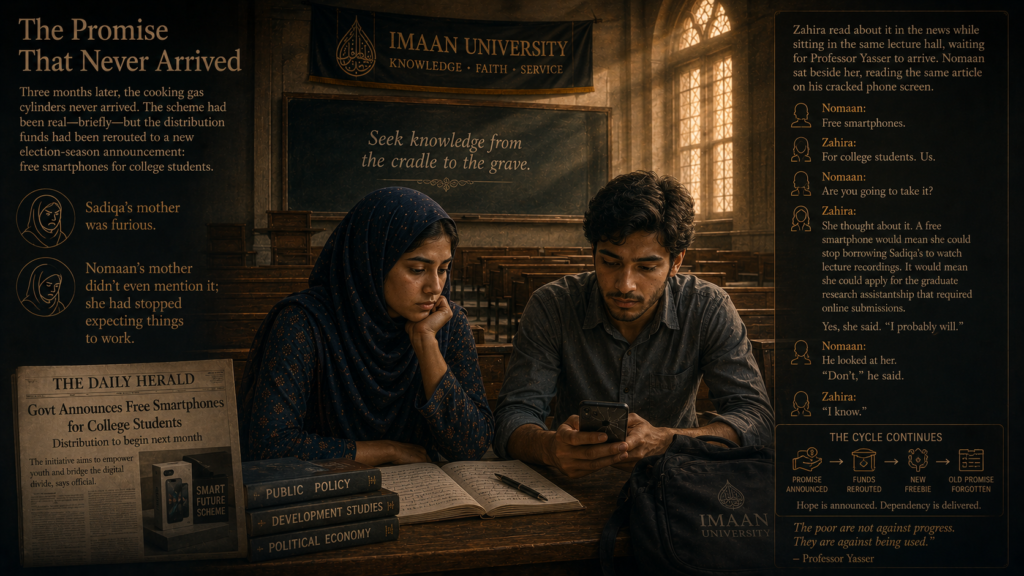
Three months later, the cooking gas cylinders never arrived. The scheme had been real—briefly—but the distribution funds had been rerouted to a new election-season announcement: free smartphones for college students. Sadiqa’s mother was furious. Nomaan’s mother didn’t even mention it; she had stopped expecting things to work.
Zahira read about it in the news while sitting in the same lecture hall, waiting for Professor Yasser to arrive. Nomaan sat beside her, reading the same article on his cracked phone screen.
“Free smartphones,” he said flatly.
“For college students. Us.”
“Are you going to take it?”
She thought about it. A free smartphone would mean she could stop borrowing Sadiqa’s to watch lecture recordings. It would mean she could apply for the graduate research assistantship that required online submissions.
“Yes,” she said. “I probably will.”
Nomaan looked at her.
“Don’t,” he said.
“I know.”
They sat in silence. The morning light came through the arched windows, golden and indifferent, falling across the banner above the blackboard: Seek knowledge from the cradle to the grave.
The Girl Inside the Jar
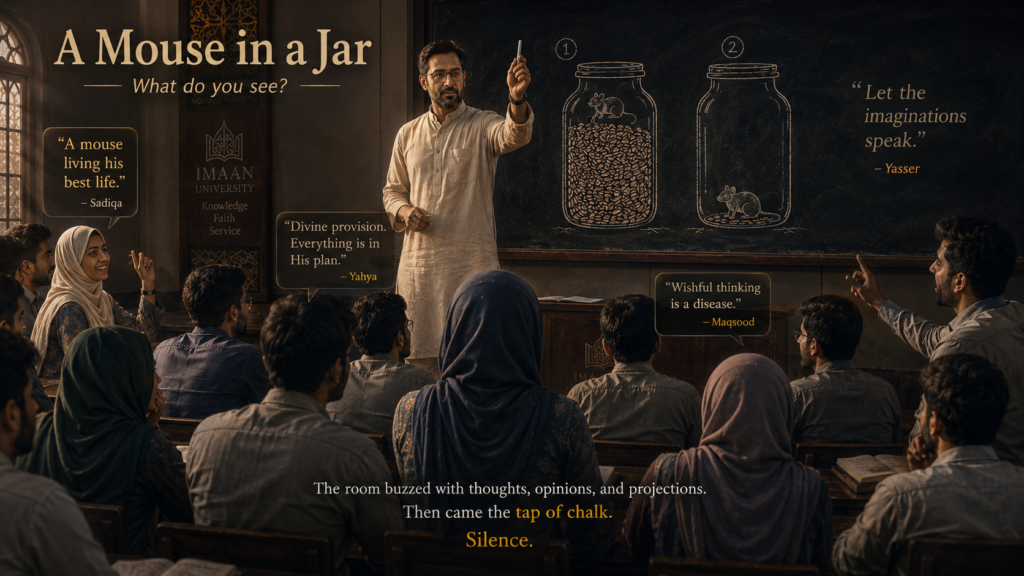
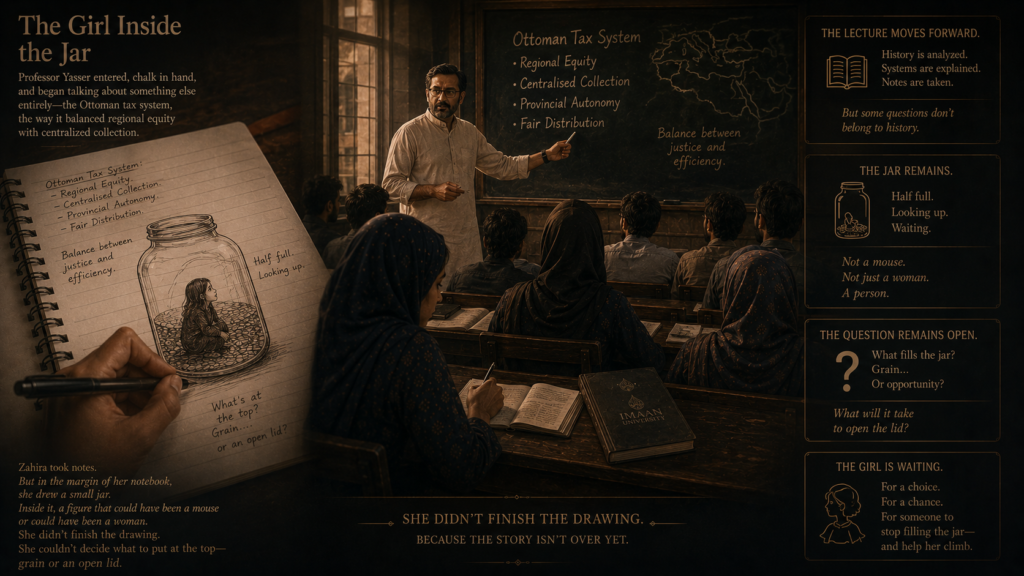
Professor Yasser entered, chalk in hand, and began talking about something else entirely—the Ottoman tax system, the way it balanced regional equity with centralized collection. Zahira took notes. But in the margin of her notebook, she drew a small jar. Inside it, a figure that could have been a mouse or could have been a woman. The jar was half full. The figure was looking up.
She didn’t finish the drawing. She couldn’t decide what to put at the top—grain or an open lid.
From the Classroom to the Streets
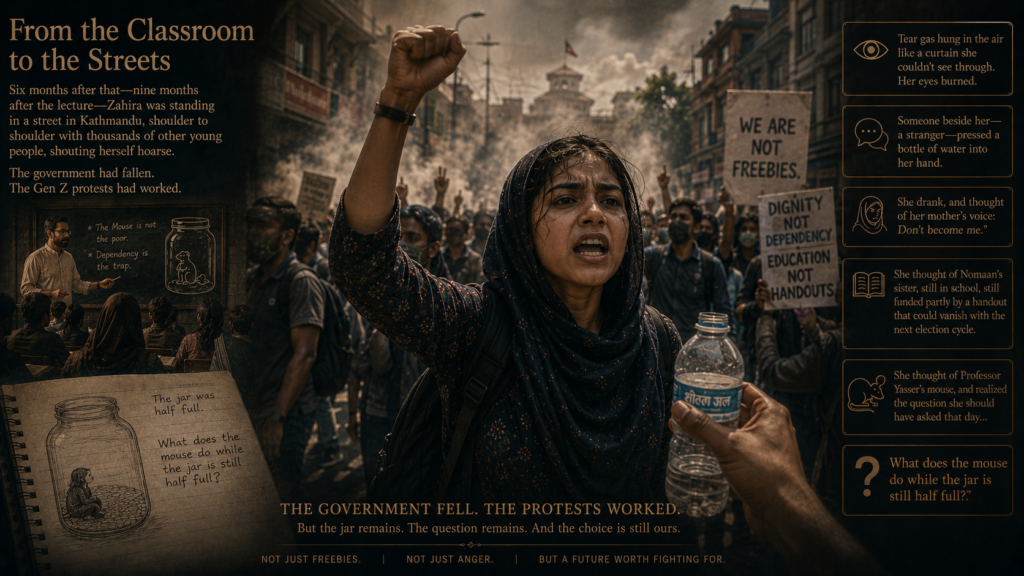
Six months after that—nine months after the lecture—Zahira was standing in a street in Kathmandu, shoulder to shoulder with thousands of other young people, shouting herself hoarse. The government had fallen. The Gen Z protests had worked. Tear gas hung in the air like a curtain she couldn’t see through. Her eyes burned. Someone beside her—a stranger—pressed a bottle of water into her hand.
She drank, and thought of her mother’s voice: Don’t become me.
She thought of Nomaan’s sister, still in school, still funded partly by a handout that could vanish with the next election cycle.
She thought of Professor Yasser’s mouse, and realized the question she should have asked that day, the question the lecture had made so clean and logical that it masked its own brutality:
What does the mouse do while the jar is still half full?
What Does the Mouse Do While the Jar Is Still Half Full?
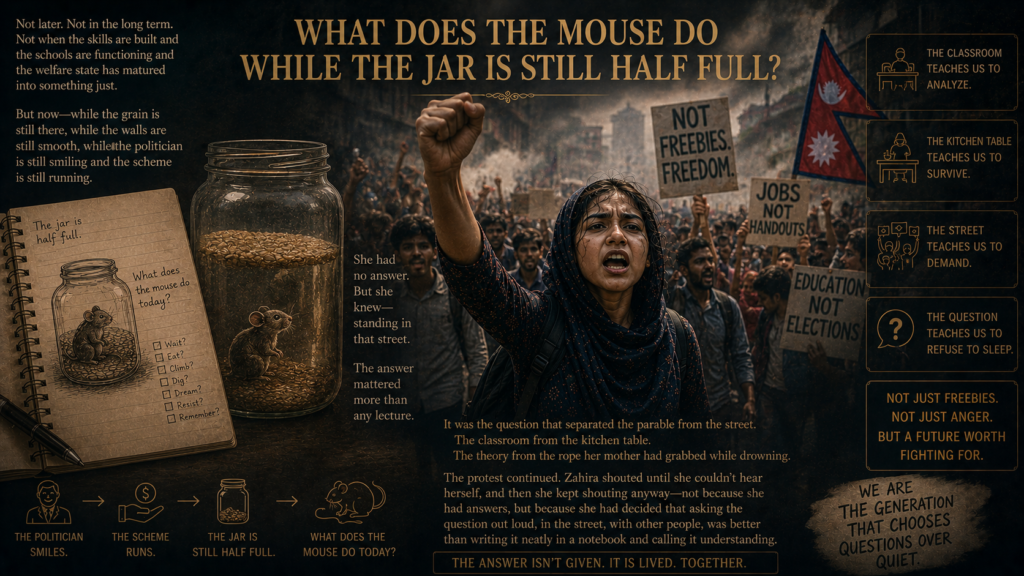
Not later. Not in the long term. Not when the skills are built and the schools are functioning and the welfare state has matured into something just. But now—while the grain is still there, while the walls are still smooth, while the politician is still smiling and the scheme is still running.
What does the mouse do today?
She had no answer. But she knew—standing in that street, throat raw, eyes stinging, surrounded by young people who had just proven they could topple a government—that the answer mattered more than any lecture. It was the question that separated the parable from the street. The classroom from the kitchen table. The theory from the rope her mother had grabbed while drowning.
The protest continued. Zahira shouted until she couldn’t hear herself, and then she kept shouting anyway—not because she had answers, but because she had decided that asking the question out loud, in the street, with other people, was better than writing it neatly in a notebook and calling it understanding.
A Nation Is Also a Choice
The Himalayan sky turned gold above them. The marigolds in the masjid courtyards swayed. Somewhere in Bharatpur, her mother was folding the gas cylinder form into her purse, just in case.
And somewhere in a lecture hall, a jar was still drawn on a blackboard, waiting for someone to decide what it meant—not in theory, not in parable, but in the place where people actually live.
Discussion Questions for Readers
1. What do you think the “mouse in the jar” represents in modern society?
2. Have you or someone you know ever depended on a government scheme during difficult times? Did it feel like temporary support—or long-term dependency?
3. What should a nation prioritize more: direct cash assistance, or long-term investments like education, jobs, healthcare, and skill development?
4. Do you believe voters should remain loyal to one political party, or should they change their vote based on performance and accountability?
5. Is dependency always a personal failure—or sometimes a systemic one?
6. What would you do if you were inside the jar?
Read the original classroom lecture that inspired this story:
“How Freebies Turn Citizens into Mice — Then into Cockroaches”
- 14 Best Panchatantra ki Kahaniya-पंचतंत्र की सम्पूर्ण कहानियाँ
- 15 Best Children Stories in English from Panchatantra 2.0
- 16 amazing Aesop ki Kahaniya-ईसप की दंतकथाएँ
- 17 Best Aesop's Fables with moral lessons for children
- Arabian Nights
- Author's Best Written Stories in English
- Author's Best Written Stories हिंदी में-लेखक की सर्वश्रेष्ठ कहानियाँ
- Baital Pachisi बैताल पचीसी हिंदी में
- Bedtime Stories for All
- Hindi Love Stories-प्रेम और रोमांस की कहानियों
- Love and Romance
- Professor Yasser Ki Class: दास्तान-ए-यासिर
- Professor Yasser's Lectures
- Vikram and Betal series: Riddle Solving Stories
You can join my WhatsApp Channel by clicking the link here


