
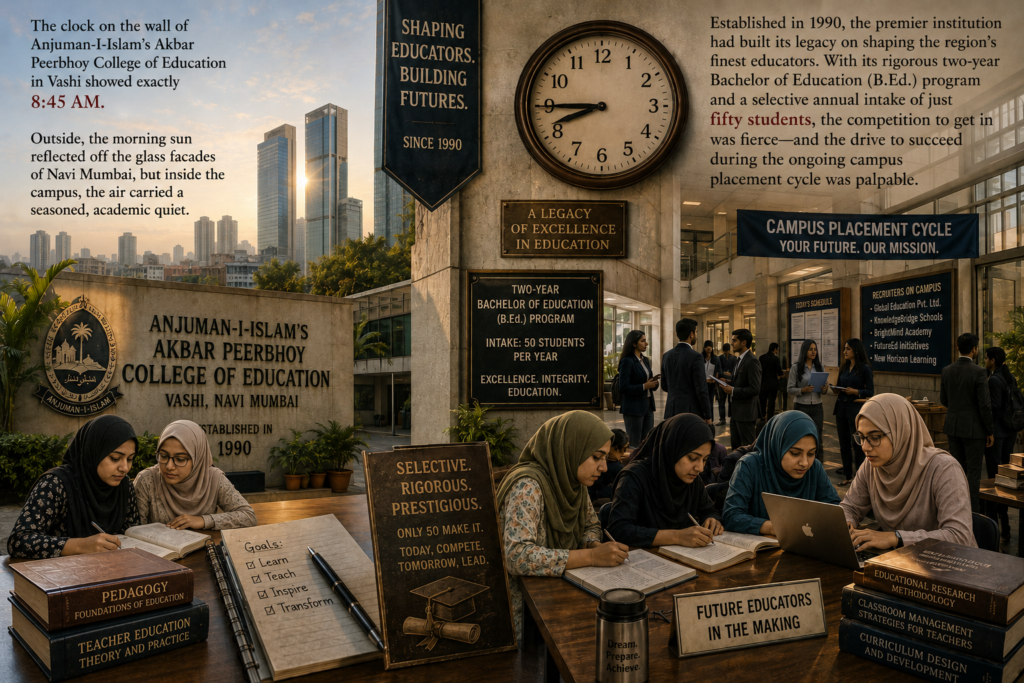
The clock on the wall of Anjuman-I-Islam’s Akbar Peerbhoy College of Education in Vashi showed exactly 8:45 AM. Outside, the morning sun reflected off the glass facades of Navi Mumbai, but inside the campus, the air carried a seasoned, academic quiet. Established in 1990, the premier institution had built its legacy on shaping the region’s finest educators. With its rigorous two-year Bachelor of Education (B.Ed.) program and a selective annual intake of just fifty students, the competition to get in was fierce—and the drive to succeed during the ongoing campus placement cycle was palpable.
The Door Opens
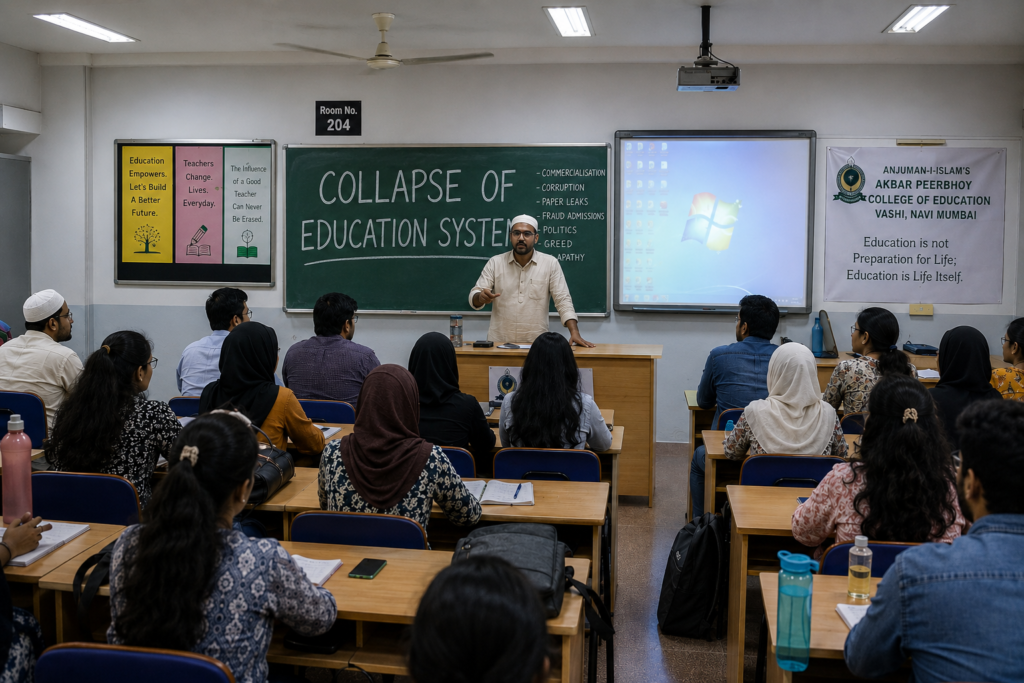
The ceiling fan in Room 204 clicked every seventh rotation. The students had learned to count it. On humid June mornings in Vashi, when the air smelled of salt and construction dust, that click was the heartbeat of the room.
Professor Yasser entered with a piece of chalk, a leather-bound book, and a projector that had been dropped twice and never quite fixed. The students rose. The chairs scraped.
“As Salaamu Alaikum, Sir.”
“Wa Alaikumus Salaam. Sit.” He didn’t say Good Morning. He hadn’t for three weeks, not since the HSC results were cancelled statewide. The students noticed. They noticed everything about Professor Yasser — how his kurta was ironed on Tuesdays but wrinkled by Thursday, how he stopped wearing his watch after the news broke, how the white dust of chalk never quite washed off his fingertips anymore.
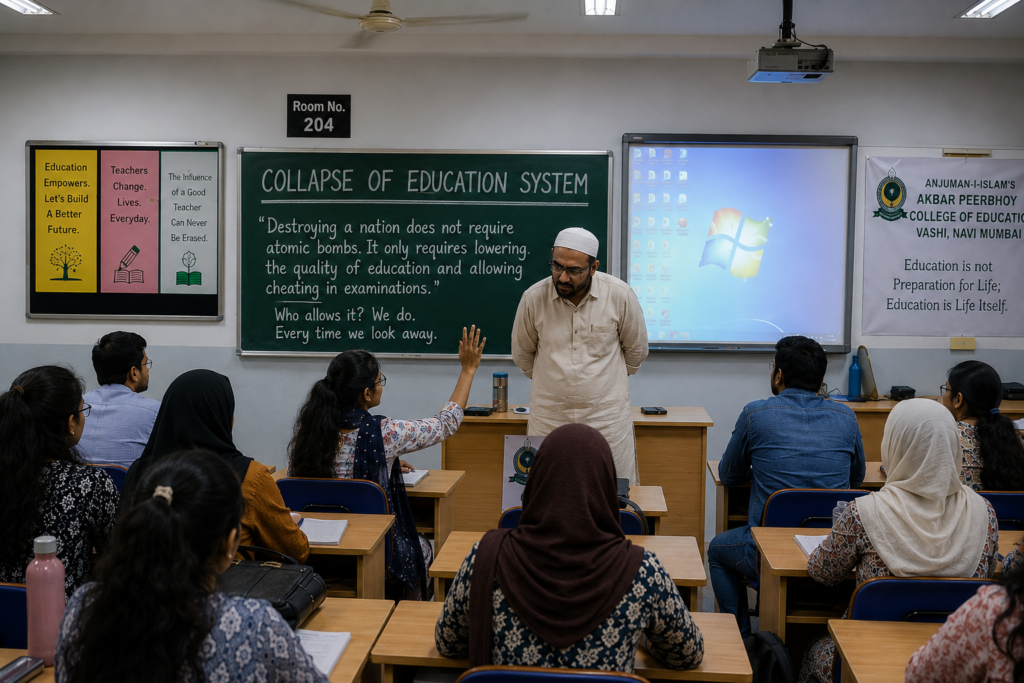
He wrote on the board in capital letters, the way a man might carve into stone:
COLLAPSE OF EDUCATION SYSTEM
Then he turned. His eyes were red-rimmed. The students had never seen him like this.
“You want to be teachers,” he said. It wasn’t a question. “You want to shape minds. Build the nation. All that… poetry.” He laughed, but it came out broken. “But who will build you? Who will ensure that when you stand in front of a classroom, you are not standing on a foundation of rot?”
He pointed at the board.
“Look at it. Sit with it. Let it make you sick. Then tell me — why is it collapsing?”
The room held its breath. The fan clicked. No one spoke. The silence itself felt like an answer.
The Girl Who Knew Too Much
Ayesha raised her hand. She always raised her hand first. It was a habit that had made her popular with teachers and lonely among peers.
“Sir, the paper leaks.”
“Paper leaks.” Professor Yasser tasted the words. “Yes. The unauthorized, illegal distribution of exam papers before the test. A breach. A betrayal. But Ayesha — why do they leak?”
Ayesha hesitated. “Corruption? Money?”
“Corruption. Money.” Professor Yasser walked to her desk. He stood too close. She could smell the chai on his breath, the sleeplessness on his skin. “My cousin sister sat for a competitive exam last year. She studied by candlelight because our inverter failed. She memorized 4,000 pages. The night before the exam, the paper was on Telegram at 11:47 PM. Eleven forty-seven. I remember the exact minute because I was awake. I was always awake.”
The class was silent. Ayesha’s hand trembled.
“She had a breakdown. Not dramatic. Quiet. She stopped eating. Then she stopped speaking. Then she stopped…” He paused. “She stopped believing that effort mattered. She is better now. She paints. She does not study anymore.”
He walked back to the board.
“Destroying a nation does not require atomic bombs. It only requires lowering the quality of education and allowing cheating in examinations.” He wrote it below the heading. “Who allows it? We do. Every time we look away.”
The Boy Who Fought Back
Imran had been leaning back, arms crossed, jaw set. He was the tech expert of the batch, the one who built apps and mocked traditions. Now he uncrossed his arms.
“Sir, with respect — you’re making it sound like a tragedy. It’s a market.”
Professor Yasser turned. “A market?”
“Yes. Supply and demand. Millions of aspirants, few seats. Desperate parents, greedy middlemen. Coaching centers selling leaked papers on WhatsApp. It’s not a moral failure, Sir. It’s economics.“
“Economics,” Professor Yasser repeated. He walked to Imran’s desk. He didn’t stand too close this time. He stood exactly far enough to make Imran feel small.
“Your father sells vegetables in Vashi market, yes?”
Imran’s jaw tightened. “Yes.”
“If a customer pays him for a kilo of tomatoes and he gives half a kilo, is that economics?”
“That’s cheating.”
“And if a rich student pays a proxy to sit an exam using forged documents, buys a seat in a medical college, becomes a doctor, and someday operates on your mother — is that economics?”
Imran’s face went white.
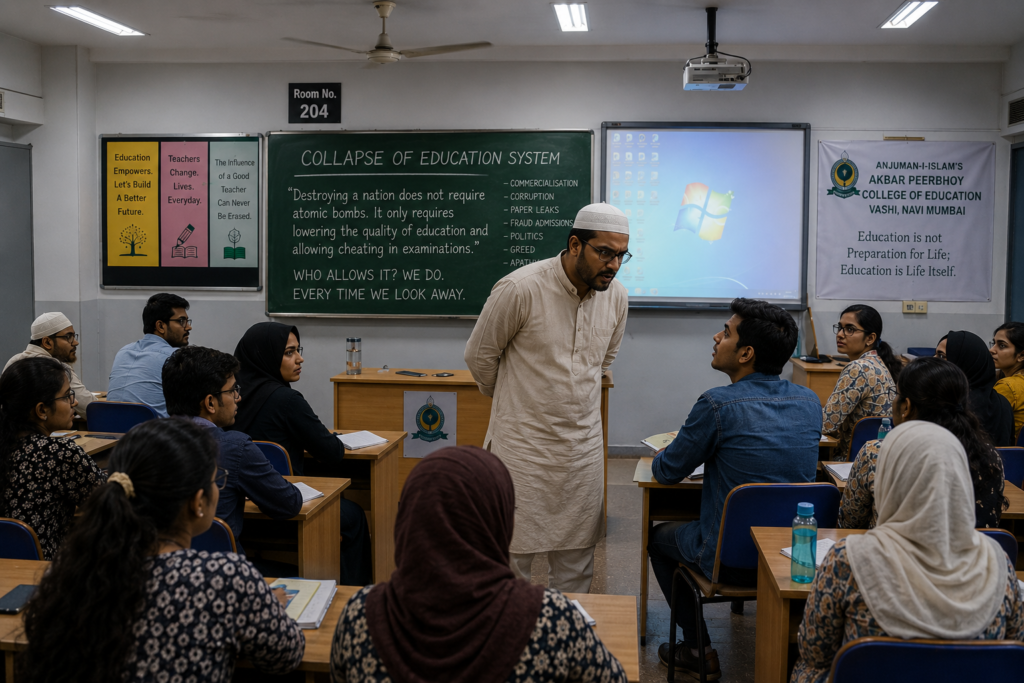
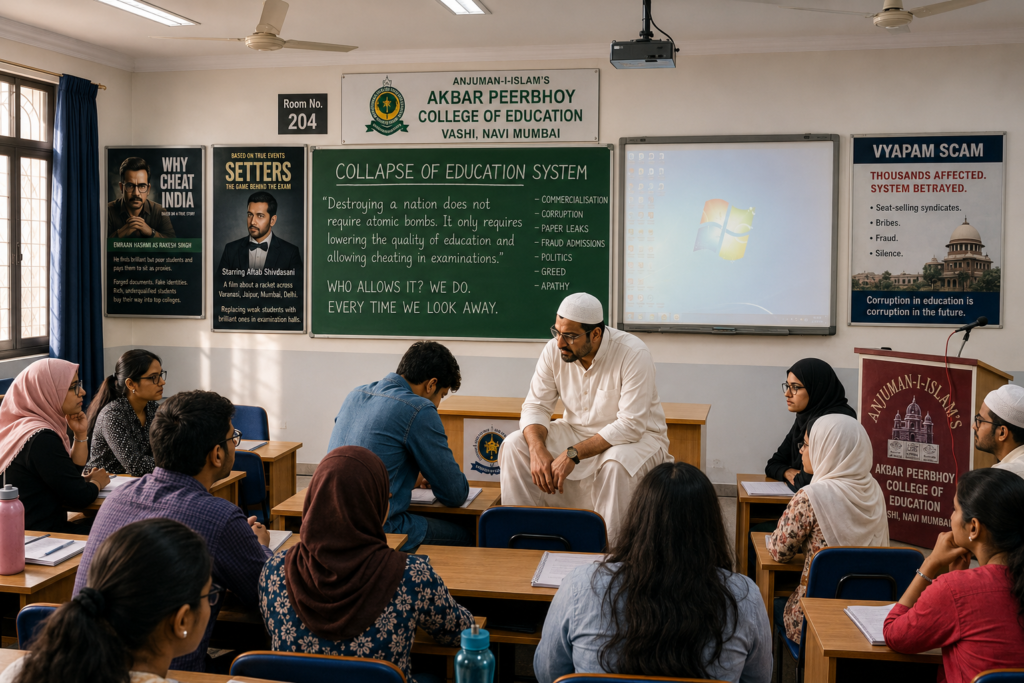
“The film Why Cheat India showed this,” Professor Yasser continued, his voice dropping. “Rakesh Singh. A fictional man who runs a real business. He finds brilliant but poor students — engineering aspirants, MBA candidates — and pays them to sit as proxies. Forged documents. Fake identities. Rich, underqualified students buy their way into top colleges. The Vyapam scam. Seat-selling syndicates. Setters — a film about a racket across Varanasi, Jaipur, Mumbai, Delhi. Replacing weak students with brilliant ones in examination halls.”
He leaned down to Imran’s level.
“Your father cheats no one, Imran. He wakes at 4 AM. He stands in rain. He comes home with hands that smell of decay. That is work. This —” he gestured at the air, at the invisible market of corruption, “— this is not economics. This is theft. The theft of your mother’s safety. The theft of your sister’s future. The theft of every honest student who believed.”
Imran looked down. His hands were shaking.
“I cheated,” he whispered.
The room gasped. Even the fan seemed to stop clicking.
“In my 12th board,” Imran said, louder now, desperate. “Physics. I was failing. My father would have been shamed. A teacher passed me a chit. I took it. I passed. I am here because of that chit. I am here, Sir. I want to be a teacher. But I am here because I cheated.”
Professor Yasser looked at him for a long time. Then he did something no one expected. He sat on Imran’s desk. He sat among the students, his authority collapsed into something else.
“Then you know,” he said quietly. “You know the weight of it. The weight of white dust that never washes off.”
The Business of Seats
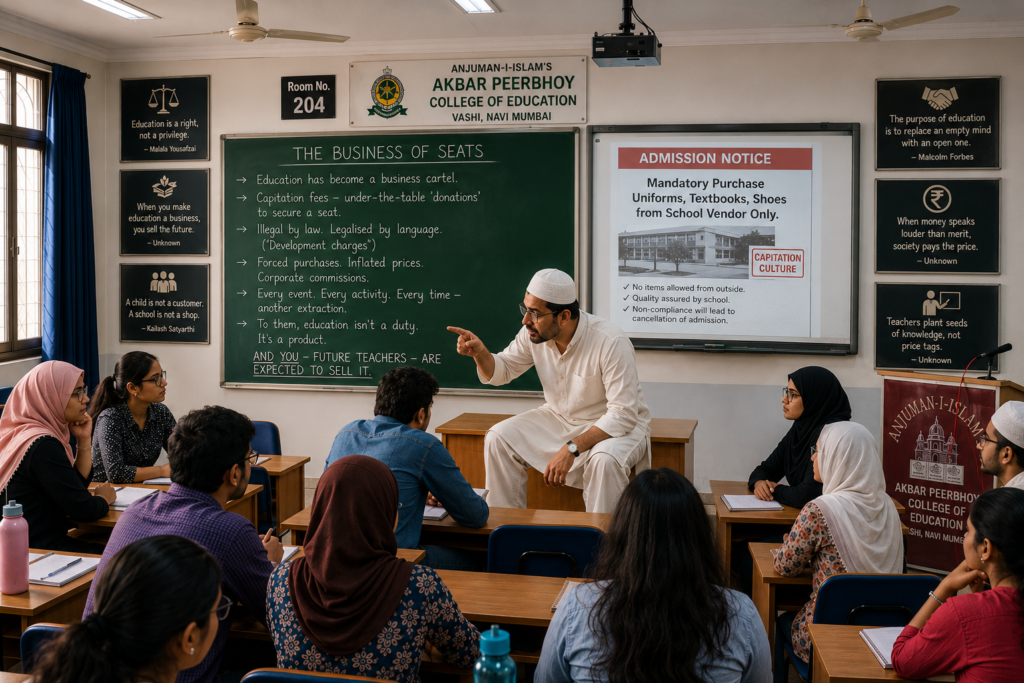
“But this isn’t just about leaks or proxies,” Professor Yasser said, his voice sharper now. “The rot goes deeper. Education has become a business cartel. Look at admission time: parents pay capitation fees — under-the-table ‘donations’ — just to secure a seat. The law says it’s illegal. The schools say it’s ‘development charges.'”
He pointed at the projector, now showing a photo of a school’s admission notice: “Mandatory Purchase: Uniforms, Textbooks, Shoes from School Vendor Only.”
“You cannot buy uniforms from outside. Why? Because the management gets a corporate commission on every thread. They sell inflated prices to families already drowning in tuition fees. And every few months — school fairs, functions, ‘mandatory events’ — all to extract more cash.”
Arifa’s face hardened. “My cousin’s school rejected a proposal to collect used textbooks from graduating students and donate them. The manager said: ‘A donated book is a lost profit margin.’“
Professor Yasser nodded. “To them, education isn’t a duty. It’s a product. And you — future teachers — are expected to sell it.“
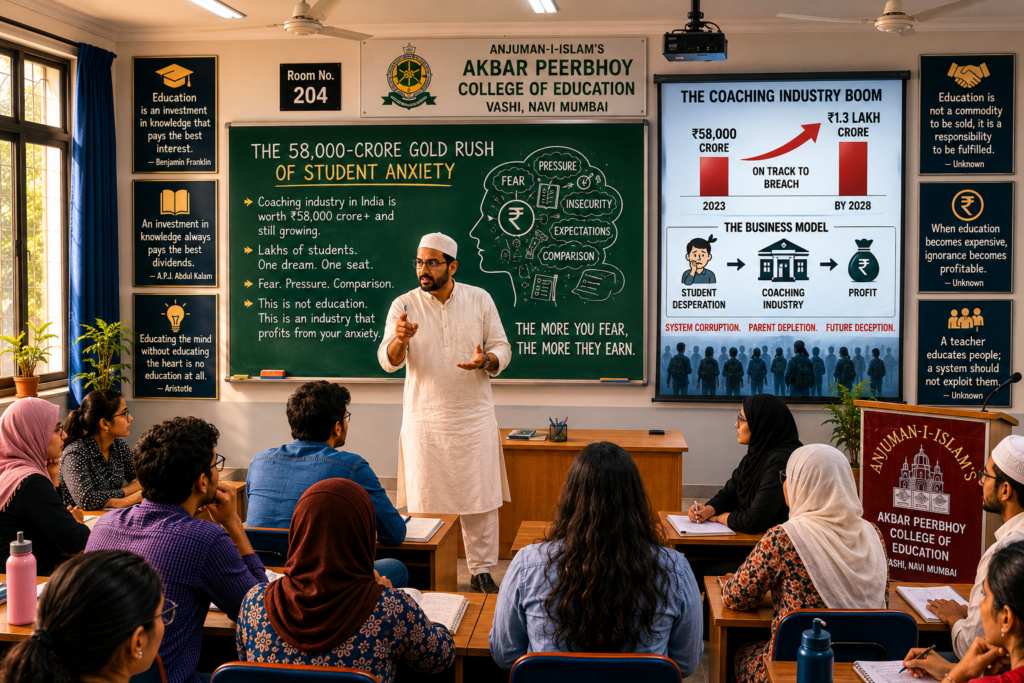
The 58,000-Crore Gold Rush of Student Anxiety
Before the heavy weight of that thought could fully settle over the room, Zafar spoke up from the middle row, a wry, cynical smile pulling at his mouth.
“Speaking of marketing a product, Professor, I want to share a funny incident involving a NEET topper who recently created history by scoring a perfect 720 out of 720.”
“Go on,” said Professor Yasser, gesturing for him to continue.
“Sir, the moment the NEET results were announced and that student made history, an absolute circus exploded online,” Zafar explained. “Within hours, multiple rival coaching centres flooded the internet with victory videos, promotional posters, and advertisements. Each one claimed this very same topper as their own, loudly proclaiming that their specific test series or study material was the secret ingredient behind his success. It was marketing at its peak.”
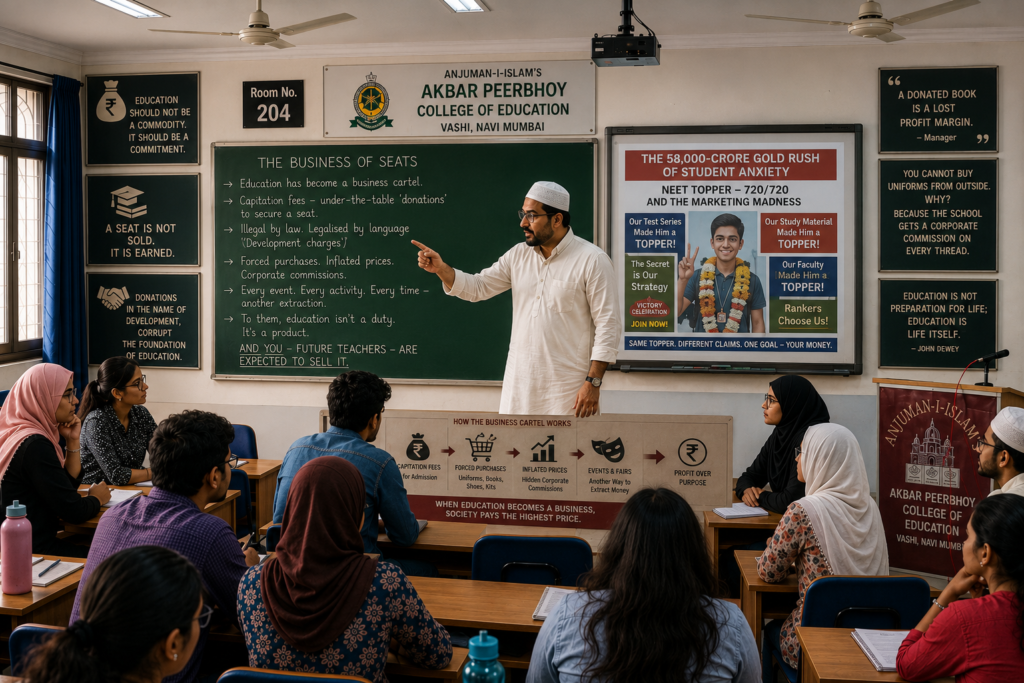
Professor Yasser shook his head, a dark flash of realization crossing his face. “That’s fascinating to hear, Zafar. But beneath the comedy lies our exact problem. You see, the modern educational apparatus has become a tool to fool the students and extract the hard-earned money from their hardworking parents.”
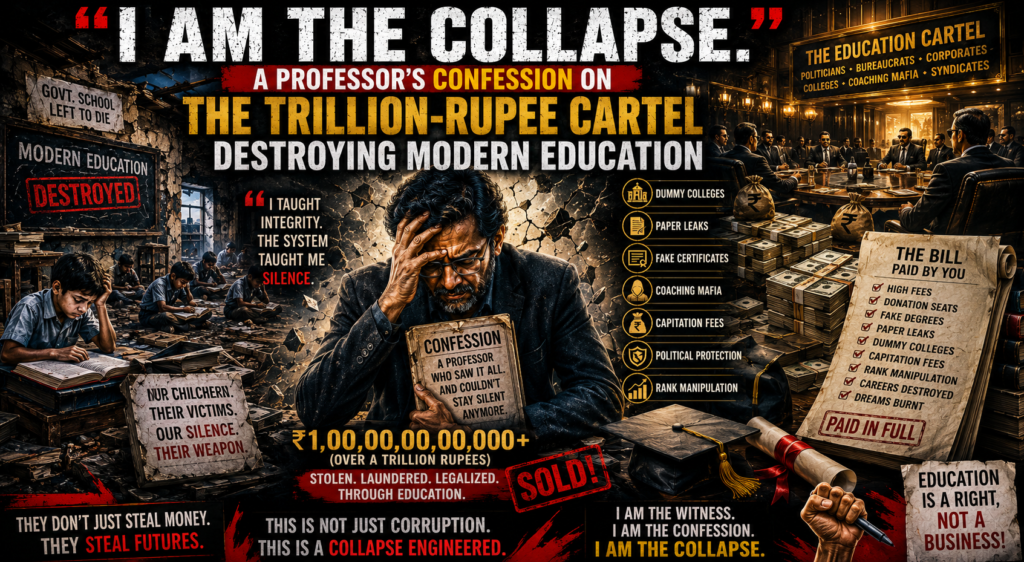
Yawar, who had remained entirely quiet near the back of the room until now, leaned forward, his voice heavy with dry realization. “No wonder the coaching industry has ballooned into a massive, ₹58,000-crore industry and is on track to breach ₹1.3 lakh crore by 2028.”
Professor Yasser leveled his sliver of chalk at Yawar like a duelist’s blade. “Precisely. It’s a masterfully engineered engine of greed, fueled by student desperation and calibrated to bleed the bank accounts of honest, hardworking parents dry.”
The Dummy School Mafia
Rahul furrowed his brow, looking across the room. “But Sir, if coaching classes are raking in ₹58,000 crore by draining traditional classrooms, shouldn’t the formal private schools and colleges be panicking? Aren’t they losing their market share?”
Professor Yasser let out a laugh—a dark, sharp, entirely humorless sound.
“Panicking? Rahul, you are assuming they are competitors. Let me ask you all a simple question: How does a high school student manage to attend a six-hour coaching class bunker every single day and still maintain the mandatory 75% attendance at their formal school?”
The room fell instantly quiet. Students traded uneasy glances.
“Dummy schools,” Kabir whispered from the side aisle.
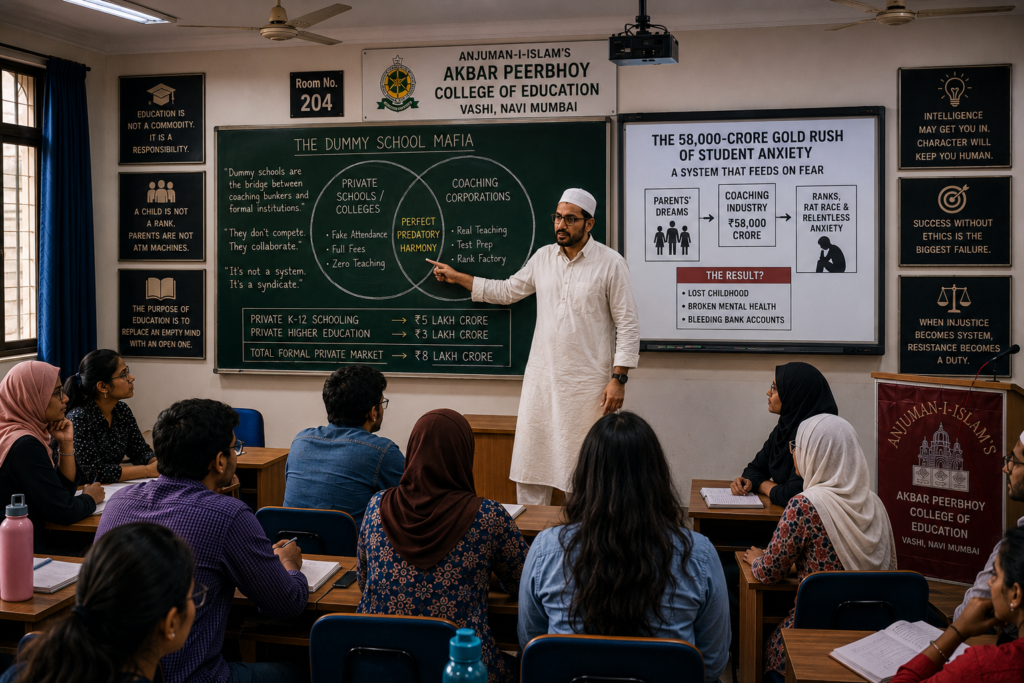
“Exactly! The integrated dummy school model,” Professor Yasser said, spinning around and sketching two massive, overlapping circles on the blackboard. “If you think the coaching industry is a monster, the formal private institutional sector is the absolute titan feeding it. They don’t compete; they exist in perfect, predatory harmony. Prominent private schools actively partner with coaching corporations. They charge desperate parents full institutional tuition fees just to fake an attendance register, while the student spends their actual youth locked inside a coaching bunker prepping for a standardized test.”
He turned back to the board, his chalk cutting sharply through the dust as he wrote out the rapid calculations:
  [Private K-12 Schooling]    -->  ₹5 Lakh Crore
  [Private Higher Education]   -->  ₹3 Lakh Crore
  --------------------------------------------------
  TOTAL FORMAL PRIVATE MARKET  -->  ₹8 Lakh Crore
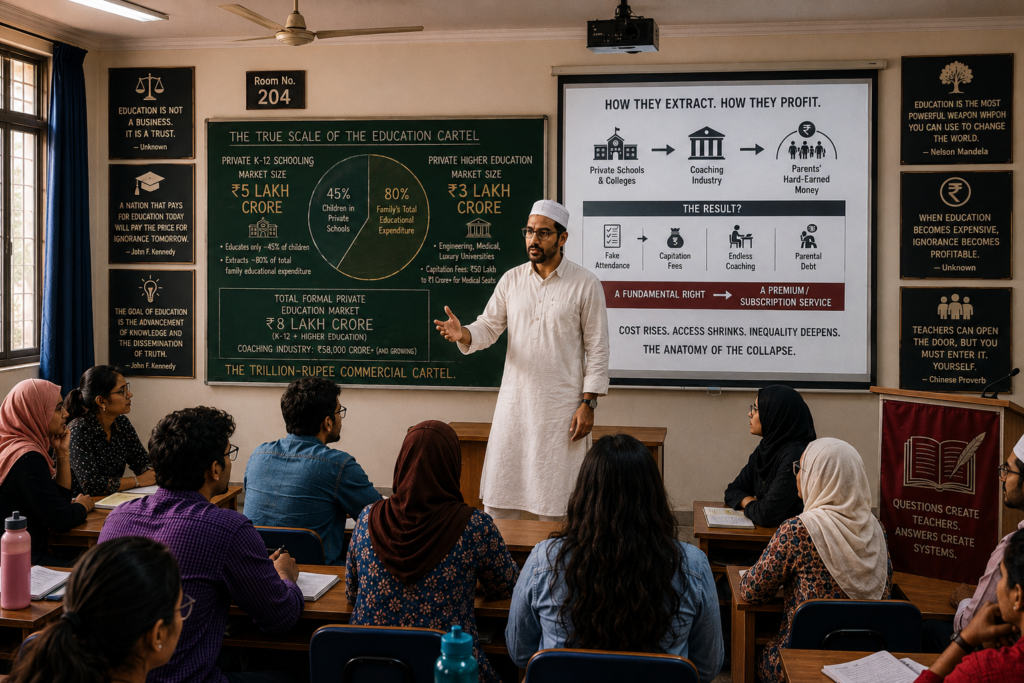
“Look at the sheer scale,” Professor Yasser continued, turning back to face the class. “The private K-12 schooling market in India is a five-lakh-crore titan. Even though private schools educate only about 45% of our children, they systematically siphon off nearly 80% of a family’s total educational expenditure. Add private higher education—the engineering, medical, and luxury universities—and you add another three lakh crore to the ledger. Think about the under-the-table capitation fees for medical seats that command anywhere from fifty lakhs to over a crore.”
He set the chalk down, the click echoing in the silence. “When you fuse the coaching engine with this private institutional empire, what do you get?”
The class sat in stunned, breathless comprehension.
“You get a trillion-rupee commercial cartel,” Professor Yasser said softly. “They have taken a fundamental, democratic right and turned it into a premium subscription service—one that gets more ruthlessly expensive every single year. And that, my dear future educators, is the anatomy of the collapse.”
Suddenly, a girl in the third row—Meher—stood up. Her hands were visibly shaking.
“Sir, my parents pay full tuition to a school I have not stepped foot in for eighteen months,” she said, her voice trembling but clear. “I sit in a coaching bunker from six in the morning until eight at night. The school fakes my attendance. My father sells auto parts. He thinks he is buying me a future. He is buying me a fraud.”
She sat down as abruptly as she had stood. No one looked at her. The weight in the room grew suffocating.
For a long moment, no one spoke. The classroom seemed to hold its breath as the old ceiling fan turned lazily overhead, its steady rhythm the only reminder that time had not stopped.
The Broken Shield and The Corporate Slaughter
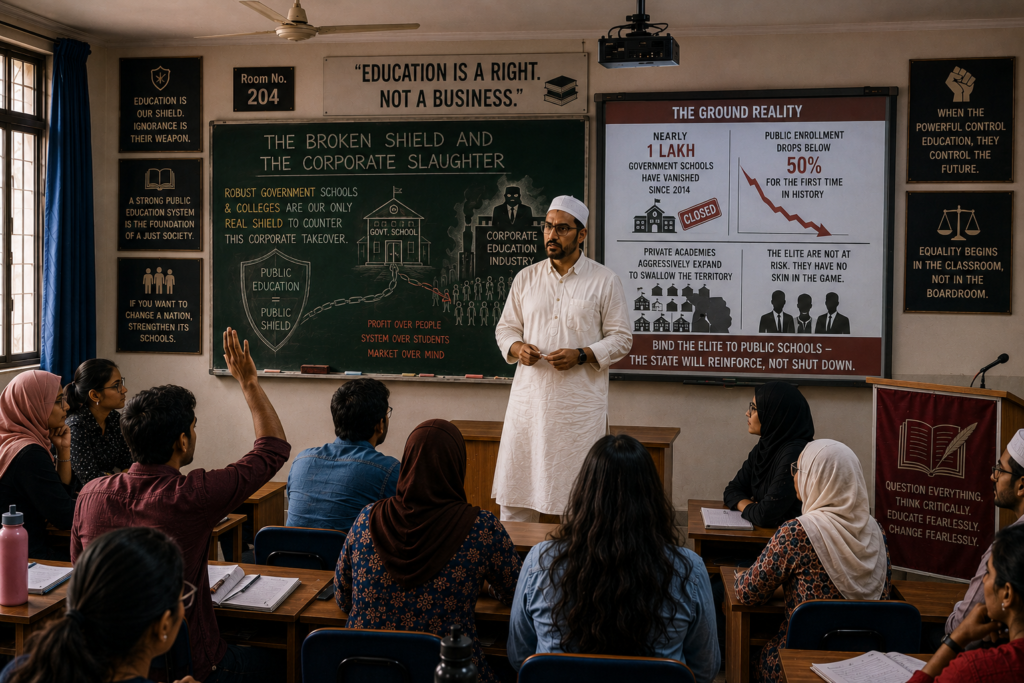
Then Professor Yasser dusted the lingering chalk from his palms, his expression grim. “And that is exactly why robust government schools and colleges are absolutely vital. They are our only real shield to counter this corporate takeover.”
Sebastian raised his hand from the front row, shaking his head gently. “Sir, that is much easier said than done. We all know the ground reality. To my mind, the only way to save our public education system is to pass a simple rule: every single child of an elected politician, government official, or MLA must study only in government schools. Let’s see how drastically things improve then.”
Professor Yasser nodded grimly. ‘Because right now, the people pulling the strings have no skin in the game. That is exactly why nearly one lakh government schools have quietly vanished since 2014—dropping public enrollment below 50% for the first time in history while private academies aggressively expand to swallow the territory. If the elite were legally bound to those desks, the state wouldn’t be shutting doors; they’d be reinforcing them.”
Systemic Classroom Decay: How the State Abandoned the Rural Mind
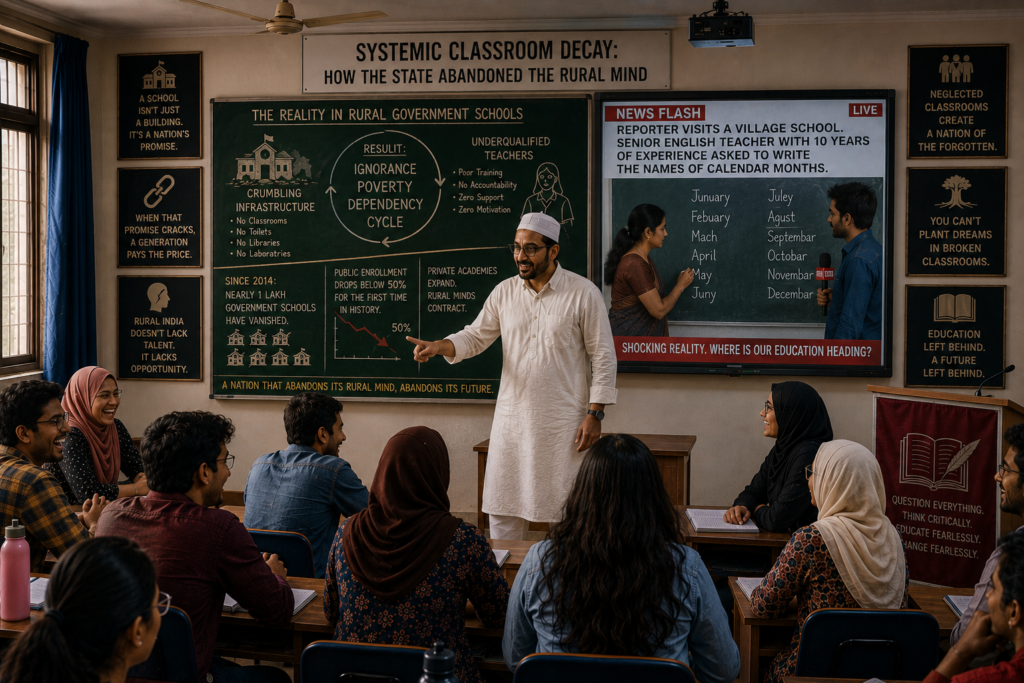
“Exactly, Professor, ”Imtiyaz chimed in. “Most government schools completely lack basic infrastructure. And the situation in rural areas is significantly worse.” He paused, a bitter, cynical smile crossing his face. “I recently watched a news broadcast. A reporter walked into a village school and asked a senior English teacher—a woman with ten years of experience—to simply write the names of the calendar months on a crumbling blackboard.”
“Then what happened?” Sebastian asked, turning in his seat.
“You won’t believe it,” Imtiyaz said, throwing his hands up. “This veteran teacher didn’t even know the correct spellings. She made glaring grammatical and spelling errors in almost every single month.”
The classroom burst into laughter—harsh, cynical, relieved laughter, the kind that leaks out when a tension becomes too heavy to bear.
Anatomy of a Failed System: Shifting Focus from the Classroom to the Real Disease
But Priya did not laugh.
She sat in the back row, a silent figure with a face like stone and a closed notebook. Though she never spoke and barely moved a muscle, her eyes burned with an intensity that belied her quiet reputation for drawing diagrams in the shadows of the classroom.
Professor Yasser noticed her immediately. He fell silent. The laughter died awkwardly, one by one, as the rest of the students followed the professor’s gaze to the girl in the back who remained completely frozen.
“Sir,” Priya said. Her voice was barely above a whisper, but it possessed a gravity that made the entire room freeze. “May I speak?”
Professor Yasser nodded slowly.
She stood up, walked deliberately down the aisle, and stepped up to the front. She didn’t stand below him; she stood right beside him, facing the room.
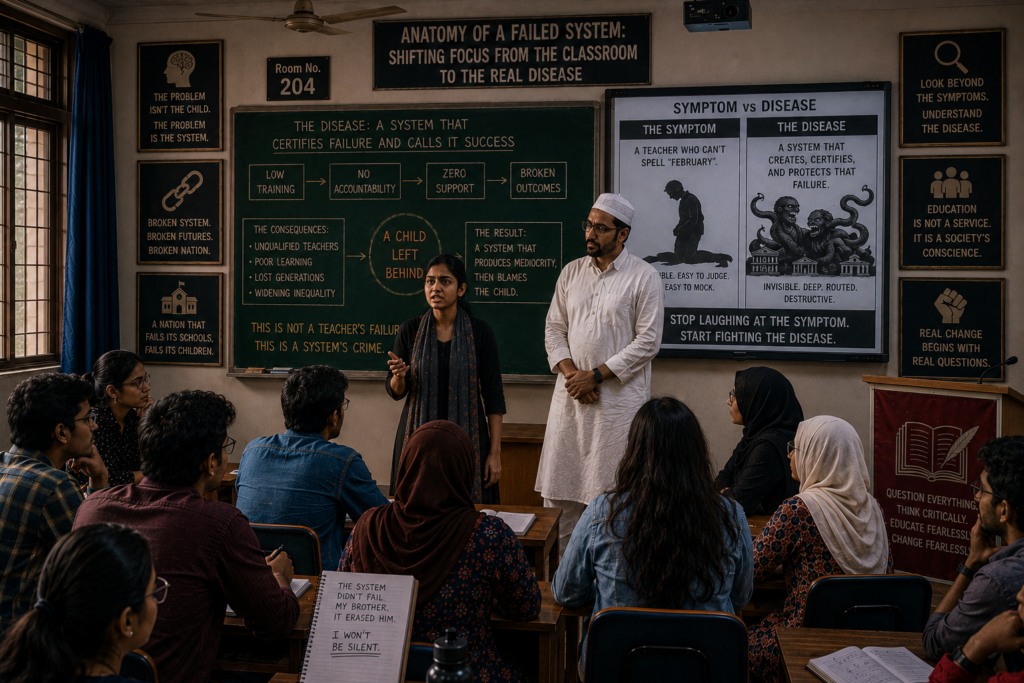
“That teacher is not funny,” Priya said, her voice cutting through the leftover amusement. “She is exactly what this system produces. A woman with ten years of service who cannot spell ‘February’ because the system that certified her is the exact same system that—”
She stopped. Her knuckles turned white as her hands began to tremble.
“The same system that what, Priya?” Professor Yasser asked, his voice incredibly gentle.
She turned her eyes to her classmates, looking at each of them in turn.
“The same system that failed my brother.”
Priya’s words hung in the air. The laughter had died completely. Professor Yasser nodded slowly, then turned back to the board.
“Priya is right,” he said. “That teacher is a symptom. But let me show you the disease.”
Systemic Fraud and the Theft of Opportunity
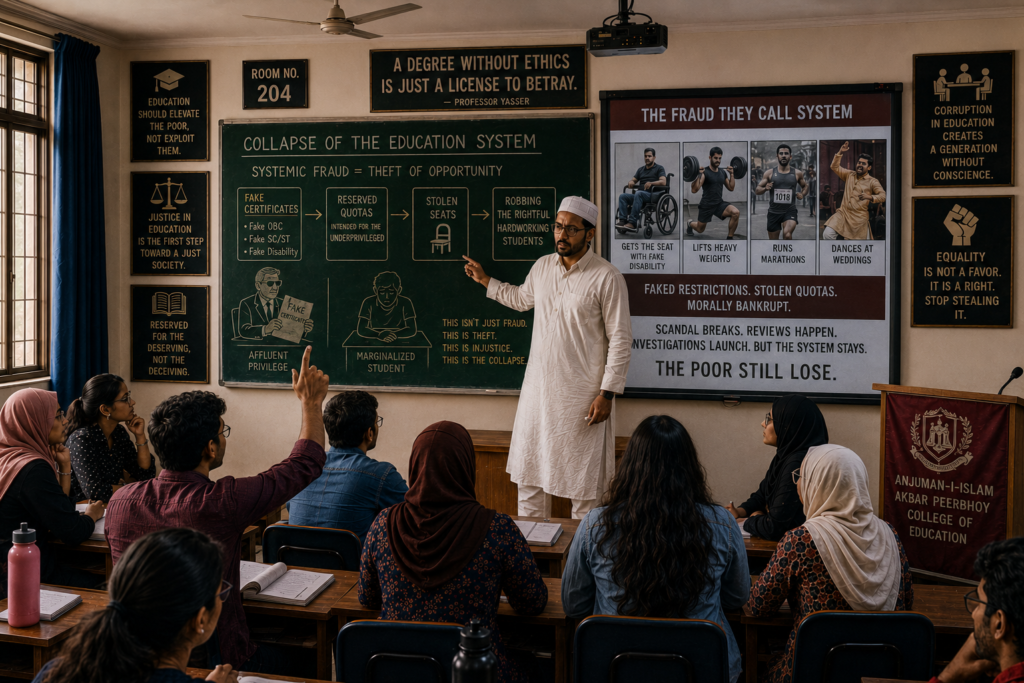
Professor Yasser walked back to the blackboard, where the words “Collapse of the Education System” were written. His face remained grim as he continued, “And it gets worse. Affluent families fabricate certificates—fake OBC, fake SC/ST, and fake disability claims. They sit for exams under reserved quotas intended for the underprivileged, effectively stealing those seats. In doing so, they rob genuine, hardworking students from marginalized communities of their rightful place.”
Rahul’s jaw tightened. “Sir, I read about officers who got into services under the locomotor disability quota. But videos surfaced of them lifting heavy weights, running marathons, dancing at weddings. They had faked their physical restrictions.”
“Exactly,” Professor Yasser said. “They weren’t disabled. They were morally bankrupt. And when a scandal breaks, an internal review launches, dozens get investigated… but the system stays. The poor still lose.”
The Girl Who Walked Out
Priya stood up. Now her voice was a knife.
“Sir, my brother was one of the 243 students in Gondia and Wardha. The Biology paper. Mass copying. They failed him. He didn’t copy. He was near copiers. The audit failed him anyway. He was innocent.”
She walked to the front. She stood beside Professor Yasser, not below him.
“In Beed district, they used drones to catch teachers dictating answers. In Washim, 581 students caught in a single Physics exam. In Himachal Pradesh, Kangra district, a superintendent and teachers verbally dictating MCQ answers. In Gujarat, 2018, nearly 1,800 students under scrutiny after CCTV audits. Bihar — family members scaling walls, passing chits through windows, police chasing them, others cheating quietly with the connivance of authorities.”
She was crying now, but her voice didn’t break.
“And the fake certificates. The fabricated disability claims. People claiming physical restrictions while performing gym workouts and dance routines on social media. My brother was innocent, Sir. And they destroyed him. He works in a call center now. He was going to be a scientist.”
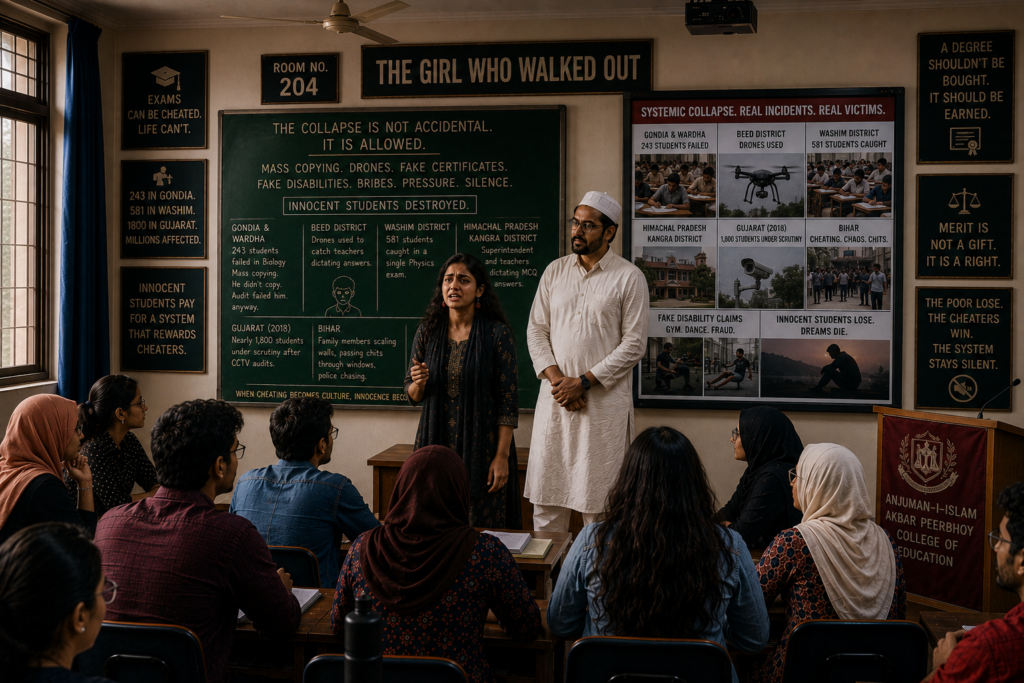
She turned to the class.
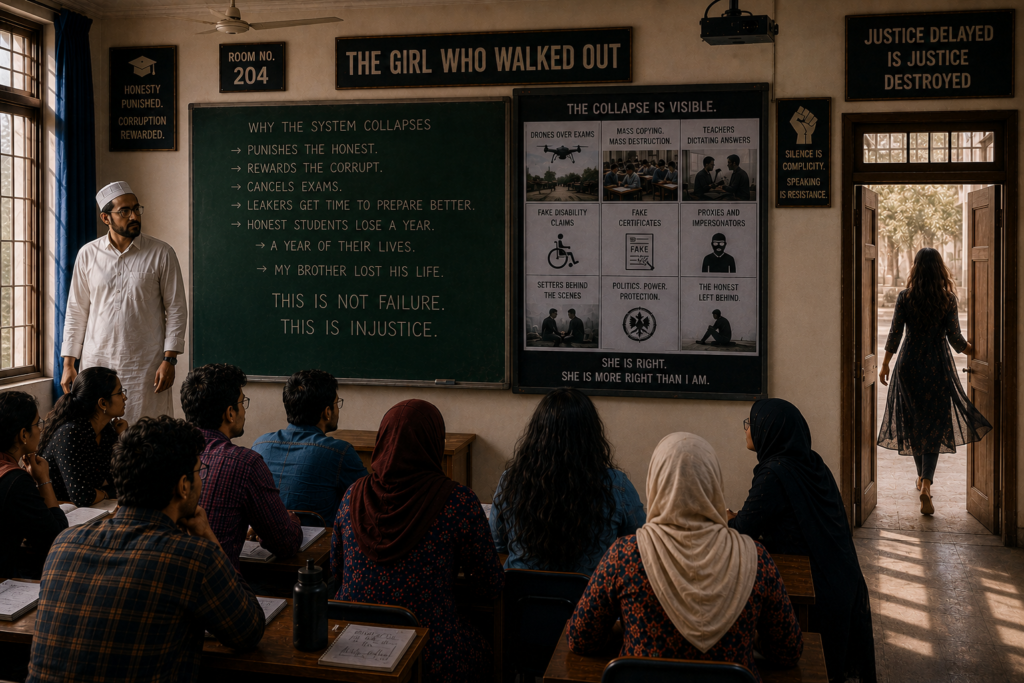
“You want to know why the system collapses? Because it punishes the honest and rewards the corrupt. Because when they cancelled the exam, the leakers got time to prepare better. The honest students lost a year. A year of their lives. My brother lost his life.”
She walked to the door. She opened it.
“And you know what, Sir? I don’t want to be a teacher anymore. I want to be a lawyer. I want to sue them. All of them. The drones, the teachers, the setters, the proxies, the fakers. I want to burn it down.”
She walked out. The door slammed. No one moved.
Professor Yasser stood slowly. He walked to the door. He didn’t open it. He just stood there, his forehead against the wood.
“She is right,” he said, his voice muffled. “She is more right than I am.”
The Confession
He turned back, his eyes misting. The students had never seen him this sad.
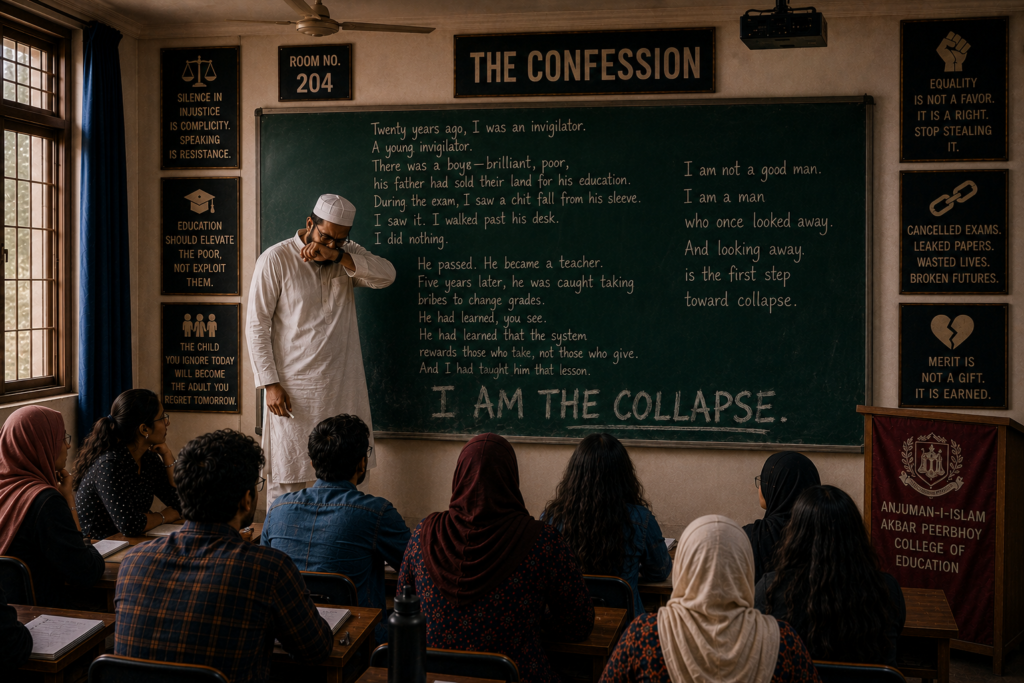
“Twenty years ago,” he said, “I was an invigilator. A young invigilator. There was a boy — brilliant, poor, his father had sold their land for his education. During the exam, I saw a chit fall from his sleeve. I saw it. I walked past his desk. I did nothing.”
He wiped his face with his sleeve, the chalk dust smearing like ash.
“I told myself it was compassion. I told myself he needed the chance. I told myself… many things. He passed. He became a teacher. Five years later, he was caught taking bribes to change grades. He had learned, you see. He had learned that the system rewards those who take, not those who give. And I had taught him that lesson.”
He walked to the board. He picked up the chalk. His hand shook so badly that the first letter was a smear.
“I am not a good man,” he said. “I am a man who once looked away. And looking away is the first step toward collapse.”
He wrote:
“I AM THE COLLAPSE.”
He turned.
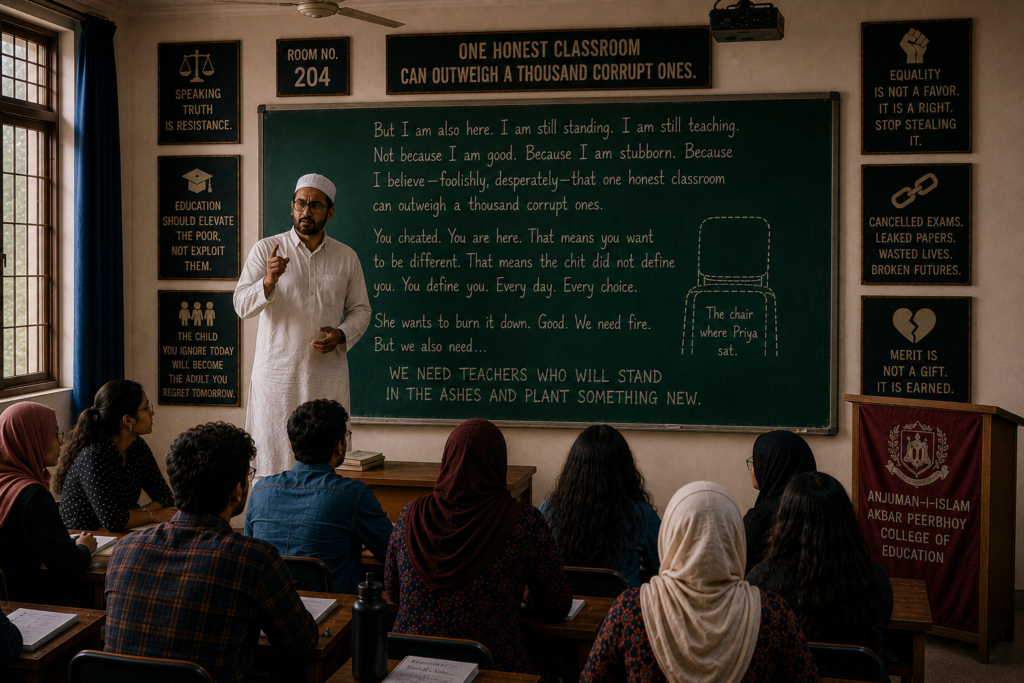
“But I am also here. I am still standing. I am still teaching. Not because I am good. Because I am stubborn. Because I believe — foolishly, desperately — that one honest classroom can outweigh a thousand corrupt ones.”
He looked at Imran.
“You cheated. You are here. That means you want to be different. That means the chit did not define you. You define you. Every day. Every choice.”
He looked at the empty chair where Priya had sat.
“She wants to burn it down. Good. We need fire. But we also need…” He paused. “We need teachers who will stand in the ashes and plant something new.”
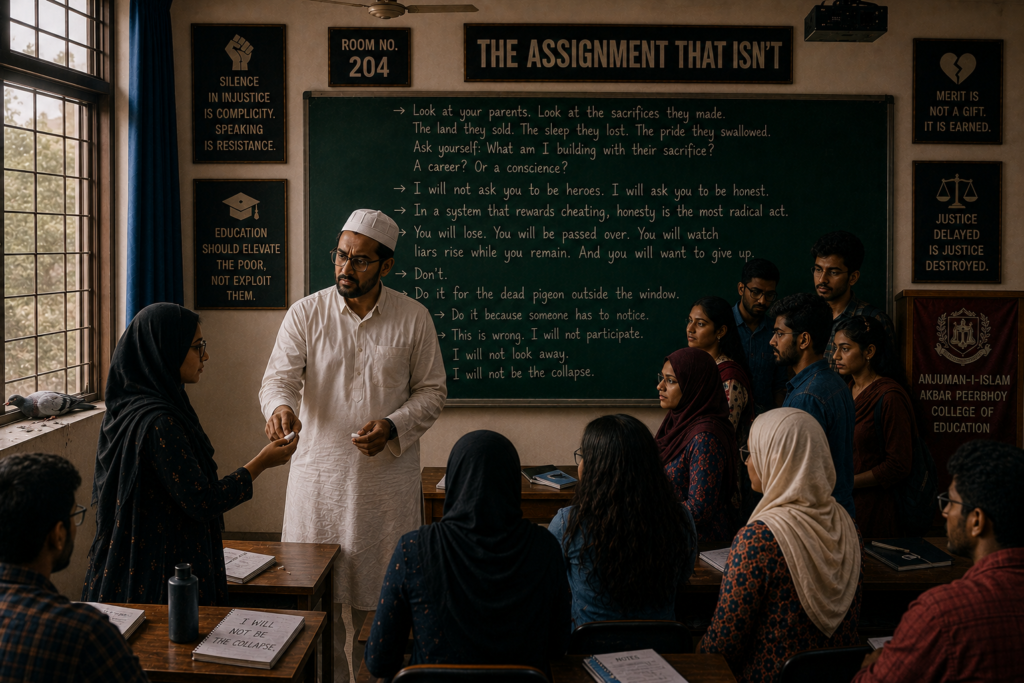
The Assignment That Isn’t
He placed the chalk in the tray. He closed the leather-bound book. He turned off the broken projector.
“Your assignment,” he said, “is to go home. Look at your parents. Look at the sacrifices they made. The land they sold. The sleep they lost. The pride they swallowed. Ask yourself: What am I building with their sacrifice? A career? Or a conscience?“
He walked to the window and found a dead pigeon there.
“I will not ask you to be heroes. I will ask you to be honest. In a system that rewards cheating, honesty is the most radical act. It is also the most exhausting. You will lose. You will be passed over. You will watch liars rise while you remain. And you will want to give up.”
He turned back. His eyes were clear now, the red rims somehow dignified.
“Don’t. Not for the nation. Not for the children. Not for any grand poetry. Do it for the dead pigeon lying on the roadside footpath while the pedestrians ignored it. Do it because someone has to notice. Someone has to say: This is wrong. I will not participate. I will not look away. I will not be the collapse.“
The bell rang. No one moved.
“Class dismissed,” he said.
But as they gathered their books, Ayesha approached him. She didn’t speak. She just held out her hand. In it was a fresh piece of white chalk.
“For tomorrow,” she said.
Professor Yasser took it. He looked at the chalk, at the white dust already on his fingers, at the smear on his sleeve.
“Tomorrow,” he repeated. “Yes. There is always tomorrow. Until there isn’t.”
Epilogue: The White Dust
That evening, Priya sat on Marine Drive. The sun bled into the Arabian Sea. Her phone buzzed — her brother, asking if she was coming home for dinner. She didn’t answer. She watched a child drawing in the sand with a stick. A ship passed on the horizon, going somewhere else.
She opened her notebook. She wrote:
I will be a lawyer. I will burn it down. But first, I will finish this degree. Because the best fire is the one lit by someone who knows what they’re burning.
Across the city, in a small apartment in Vashi, Imran sat before his father. The vegetable seller, hands smelling of decay, listened as his son confessed. When Imran finished, the old man was silent for a long time. Then he said:
“You told him. That is the first honest thing you have done. Now do the second.”
“What is the second?”
“Become the teacher who would have stopped you.”
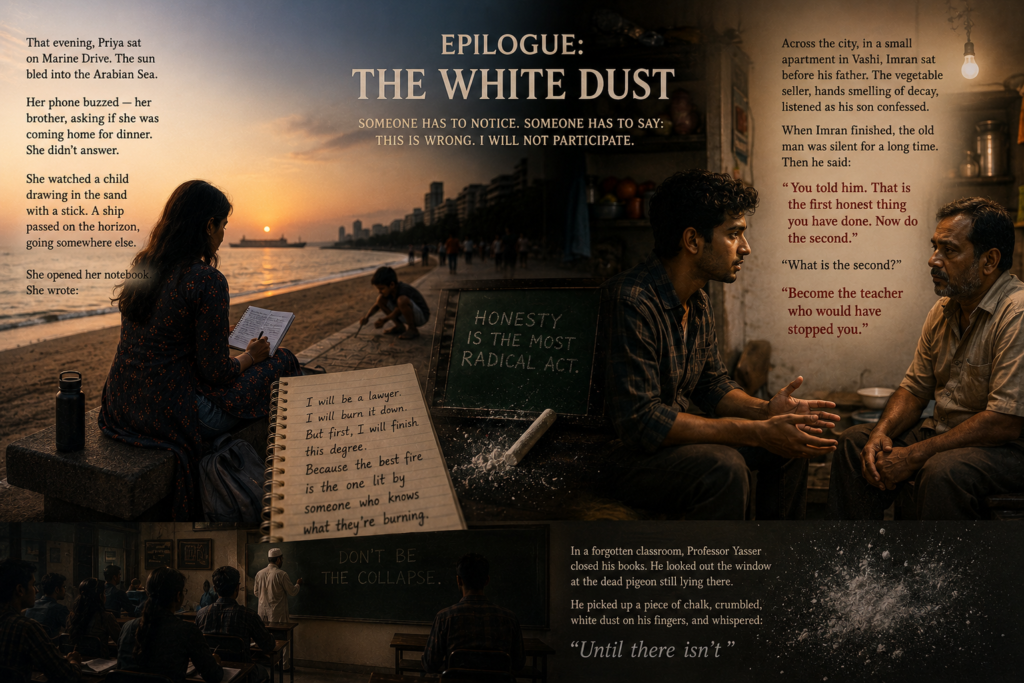
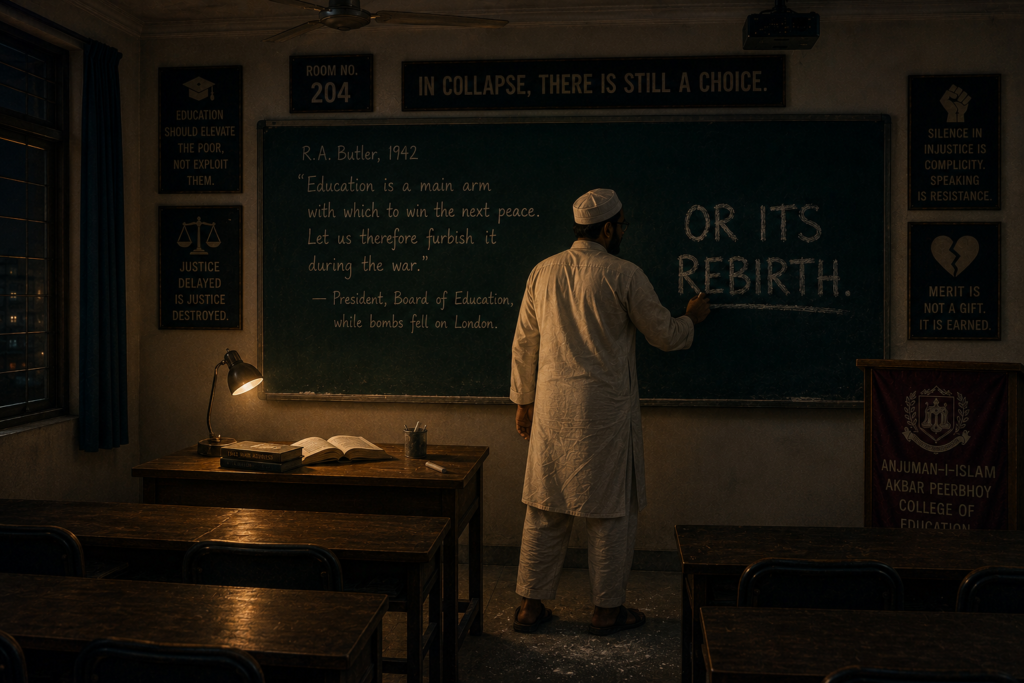
In Room 204, the ceiling fan clicked. Professor Yasser sat alone in the dark, the new chalk on his desk, the old chalk dust on his fingers. He opened the leather-bound book — the 1942 speech by R.A. Butler, President of the Board of Education, speaking while bombs fell on London.
He read aloud to the empty room:
“Education is a main arm with which to win the next peace. Let us therefore furbish it during the war.”
“Furbish,” he whispered. “Polish. Renew. Improve.”
He looked at the board. His own words still there: I AM THE COLLAPSE.
He stood. He picked up the chalk. He erased the sentence. It took longer than he expected — the chalk had dug deep. When it was gone, he wrote:
“OR ITS REBIRTH.”
He stepped back. The words were crooked. The R was smudged. The dust settled on his shoes.
It was not perfect. It was not beautiful. It was honest.
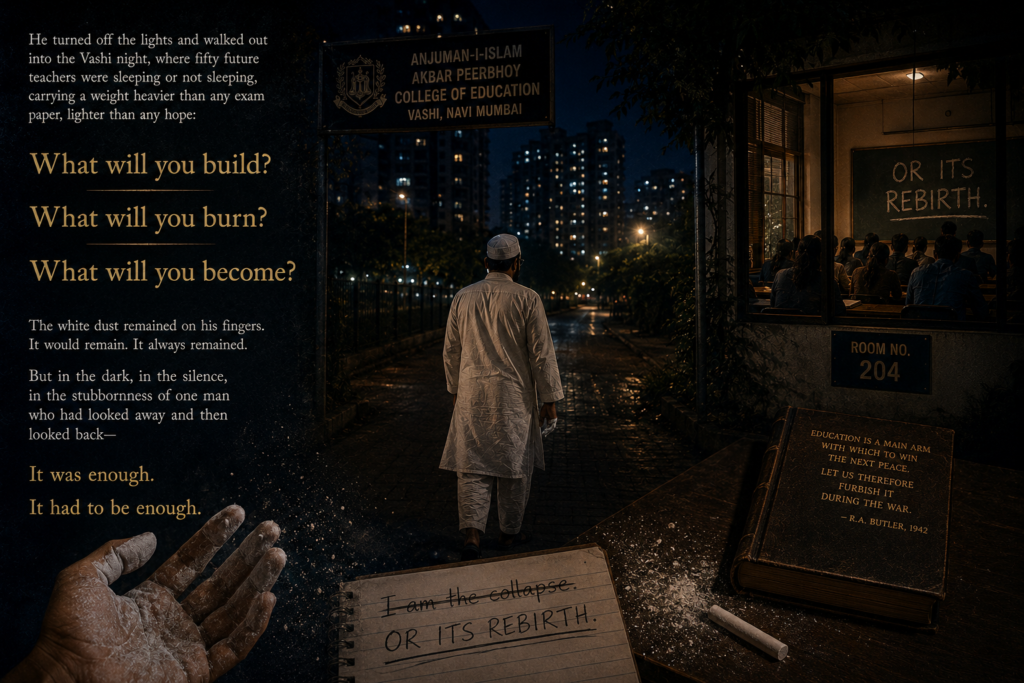
He turned off the lights and walked out into the Vashi night, where fifty future teachers were sleeping or not sleeping, carrying a weight heavier than any exam paper, lighter than any hope:
What will you build?
What will you burn?
What will you become?
The white dust remained on his fingers. It would remain. It always remained. But in the dark, in the silence, in the stubbornness of one man who had looked away and then looked back —
It was enough.
It had to be enough.
Years later, in a courtroom in Nagpur, a young lawyer stood before the bench. She was arguing a landmark case against a network of dummy schools and certificate forgers. Her name was Priya. She had finished her degree. And she was burning it down—with the law.
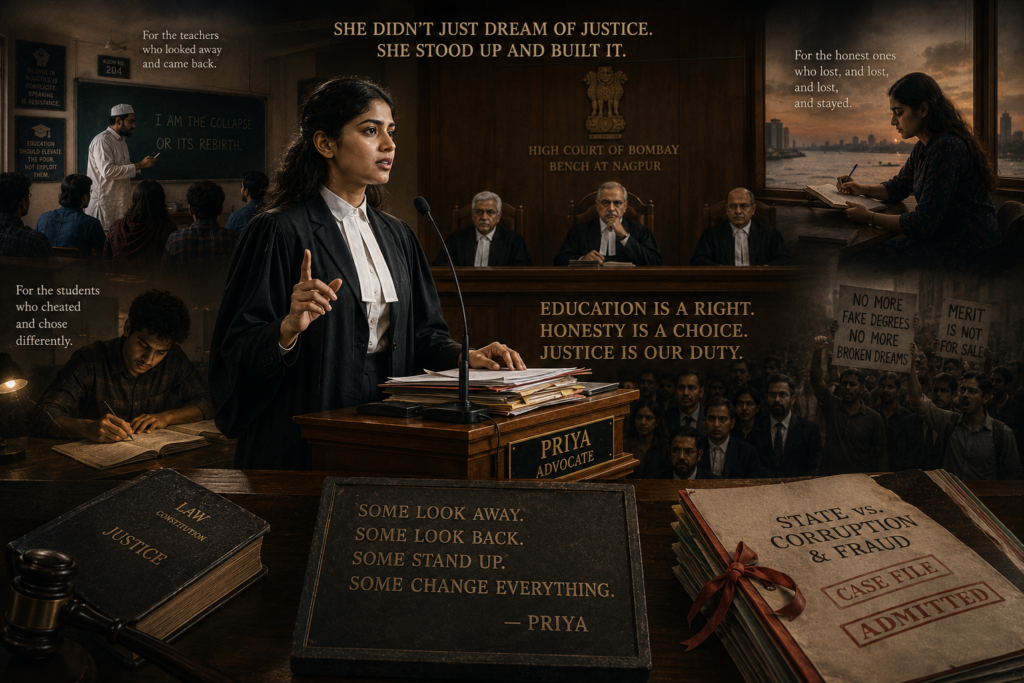
THE END
For the teachers who looked away and came back.
For the students who cheated and chose differently.
For the honest ones who lost, and lost, and lost, and stayed.
Read the original classroom lecture that inspired this story:
- 14 Best Panchatantra ki Kahaniya-पंचतंत्र की सम्पूर्ण कहानियाँ
- 15 Best Children Stories in English from Panchatantra 2.0
- 16 amazing Aesop ki Kahaniya-ईसप की दंतकथाएँ
- 17 Best Aesop's Fables with moral lessons for children
- Arabian Nights
- Author's Best Written Stories in English
- Author's Best Written Stories हिंदी में-लेखक की सर्वश्रेष्ठ कहानियाँ
- Baital Pachisi बैताल पचीसी हिंदी में
- Bedtime Stories for All
- Hindi Love Stories-प्रेम और रोमांस की कहानियों
- Love and Romance
- Professor Yasser Ki Class: दास्तान-ए-यासिर
- Professor Yasser's Lectures
- Vikram and Betal series: Riddle Solving Stories
You can join my WhatsApp Channel by clicking the link here


