

The Morning Salaam
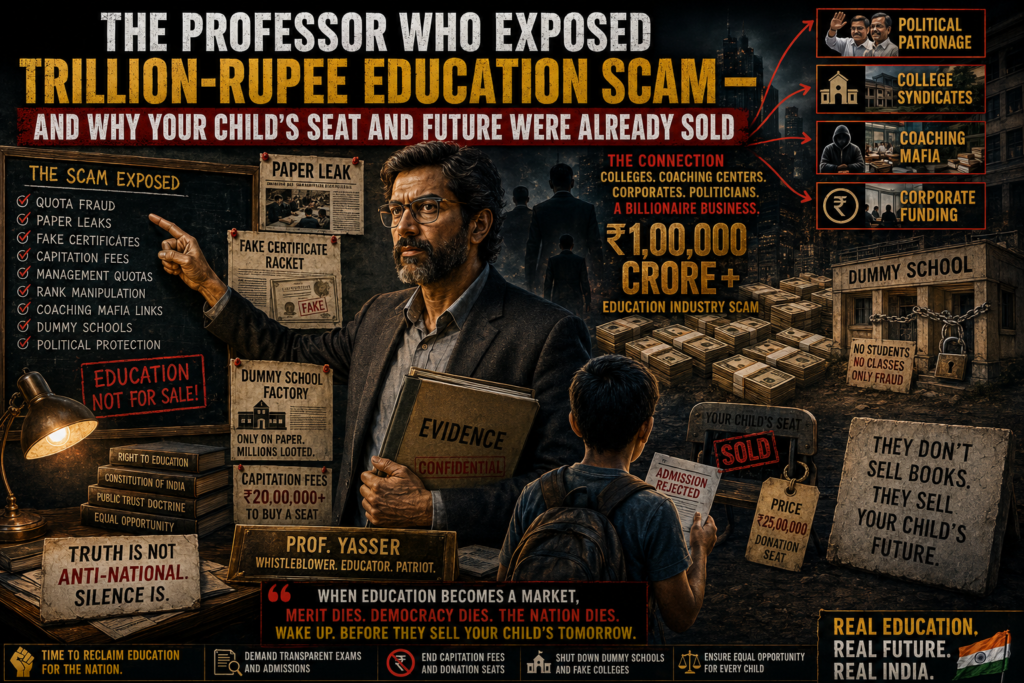
The clock on the wall of Anjuman-I-Islam’s Akbar Peerbhoy College of Education in Vashi showed exactly 8:45 am. The soft hum of the air conditioner mixed with the rustle of notebooks as 50 B.Ed students waited. The door swung open, and in walked Professor Yasser—a solid, 40-year-old figure with a salt-and-pepper beard, round spectacles, and eyes that carried the weight of two decades of teaching.
In his right hand was a worn leather briefcase; in his left, a piece of chalk and a sleek portable projector. He moved with the deliberate calm of a man who knew that the future of the nation was sitting right in front of him.
The students rose in unison. Their voices merged into a warm, respectful greeting: “As Salaamu Alaikum.”
Professor Yasser’s face softened into a gentle smile. “Wa Alaikumus Salaam and Good Morning, everyone. Please be seated.”
He placed the projector on the table, connected it to his laptop, and walked to the blackboard. The chalk squeaked as he wrote in bold, uncompromising letters:
“THE COLLAPSE OF EDUCATION SYSTEM.”
He underlined it twice, the sound echoing like a warning bell in the silent room.
The Unsettling Question
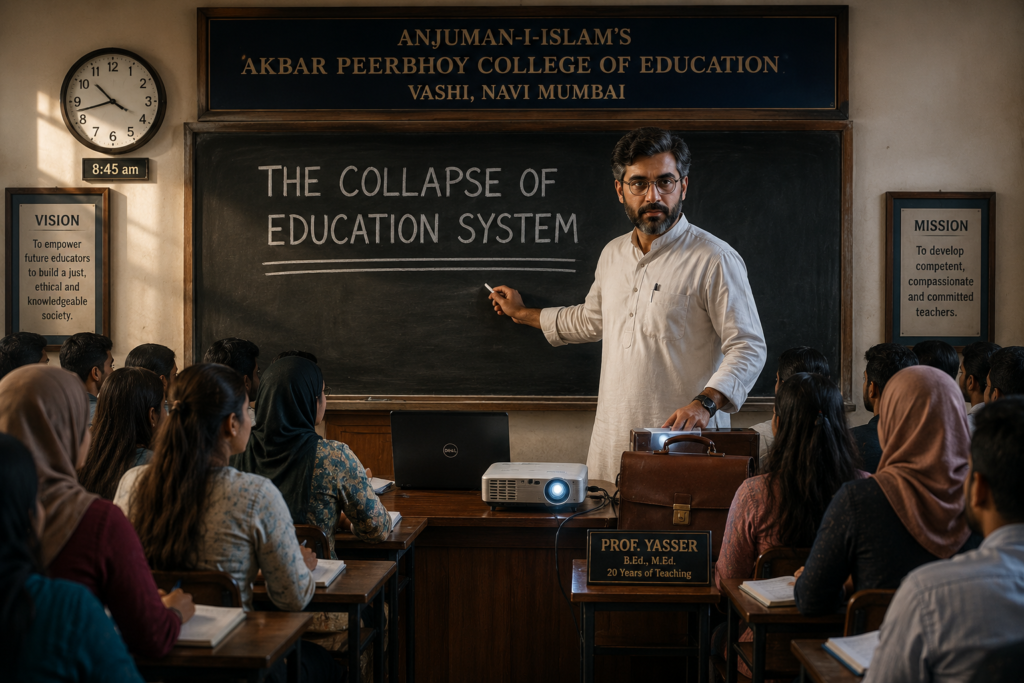
Turning to face his students, Professor Yasser leaned casually against his desk. “Dear students, you are here with a noble purpose—to become teachers, to impart knowledge, to nurture the best minds who will lead our great nation. But look around you. Our education system is gasping for air. Evil, organized forces are systematically dismantling it from within. I want you to look at the board, sit with this thought, and tell me—what are the roots of this collapse?”
Arifa, a bright-eyed girl in the front row, raised her hand hesitantly. “Sir, is it about the paper leaks we keep reading about? Where question papers are sold like vegetables in a market?”
“Excellent starting point, Arifa,” Professor Yasser nodded. “But that is merely the tip of the iceberg. Let me begin with a quote I recently read: ‘Destroying any nation does not require atomic bombs or long-range missiles. It only requires lowering the quality of education and allowing cheating in examinations.’ Today, we are doing that brilliantly—and we are paying the price.”
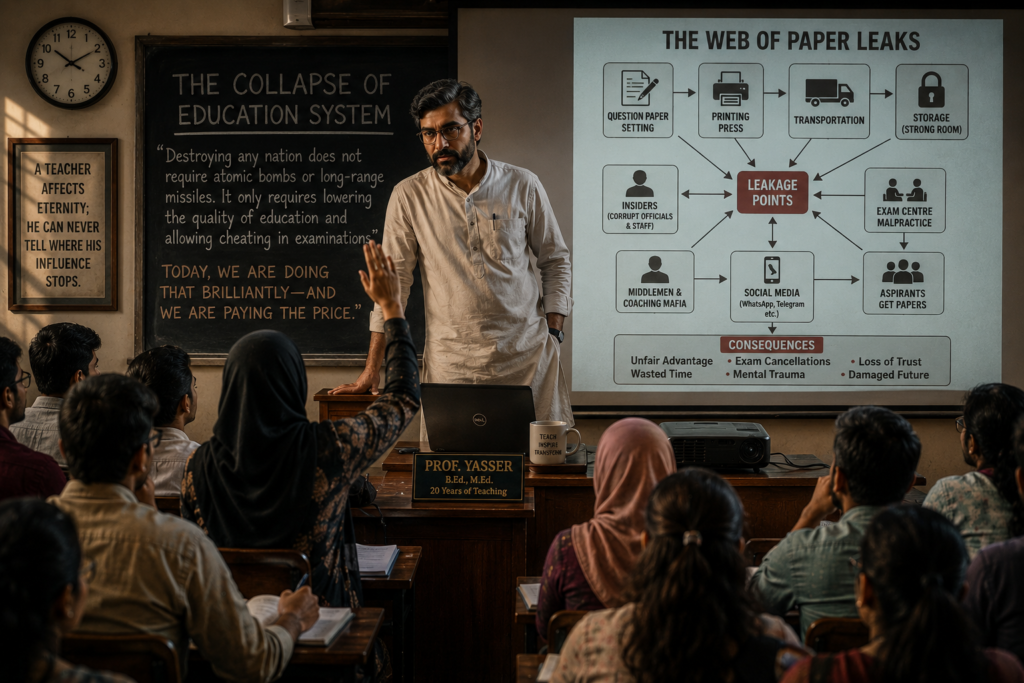
He clicked the projector. The screen lit up with a flowchart showing the intricate web of paper leaks.
The Anatomy of a Leak and the Digital Pandemic
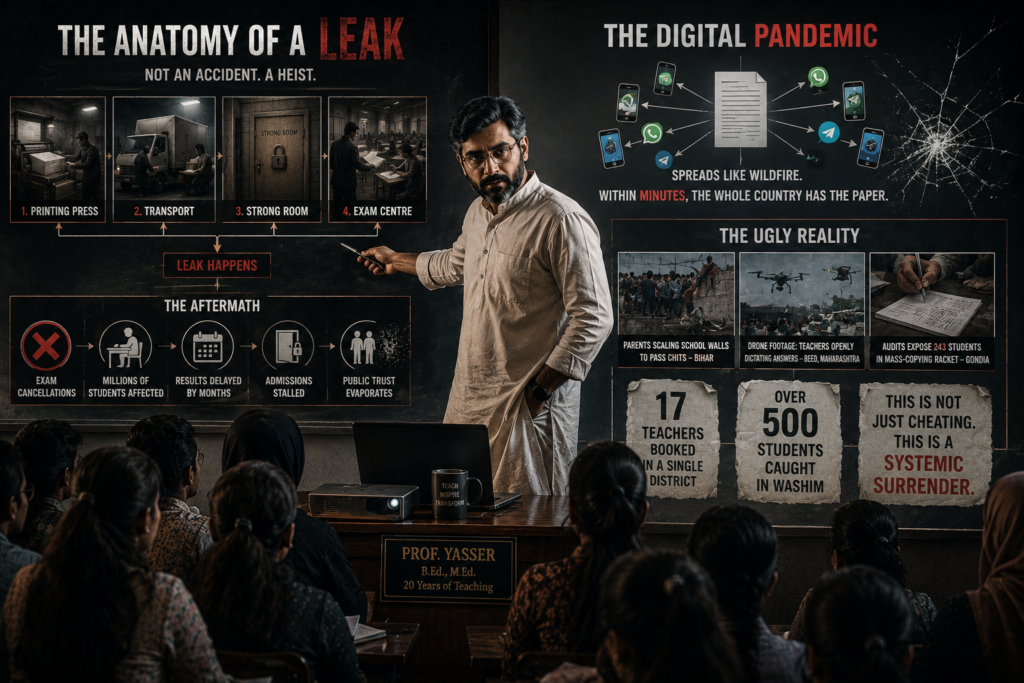
“Let us understand the mechanics,” he said, pacing slowly. “A paper leak is not an accident. It is a heist. It happens at the printing press, during transport to strongrooms, or right at the examination center when corrupt supervisors open sealed packets early.”
Avanti, a sharp student sitting in the second row, interjected. “Sir, but in the digital age, it spreads like wildfire. WhatsApp, Telegram—within minutes, the whole country has the paper.”
“Precisely, Avanti,” Professor Yasser nodded. “And when a leak is discovered, what happens? Exam cancellations. Millions of students forced to study all over again. Results delayed by months. Admissions stalled. And most tragically—public trust in the entire system evaporates into thin air.”
He pulled up archival photographs on the screen—parents scaling school walls in Bihar to pass chits, drone footage from Maharashtra showing teachers openly dictating answers in Beed, and audits exposing 243 students caught in mass-copying rackets in Gondia.
“Look at this,” he said, pointing at the images. “Teachers—the very custodians of integrity—openly dictating answers. Seventeen teachers booked in a single district. Over five hundred students caught in Washim. This is not just cheating. This is a systemic surrender.”
Celluloid Reflections of a Broken Reality
“It’s like those movies, sir,” muttered Rohit, looking at his notebook. “Have you seen Why Cheat India or Setters?”
Professor Yasser smiled faintly. “Cinema often reflects our deepest societal rots, Rohit. Tell the class what you mean.”
Rohit stood up. “In Why Cheat India, we see an organized educational mafia running a lucrative scam. They target brilliant but financially struggling engineering or MBA students. They pay these bright minds to act as ‘proxies,’ using forged documents to write entrance exams on behalf of rich, underqualified students who are simply buying their way into top colleges. It’s a multi-million rupee seat-selling syndicate.”
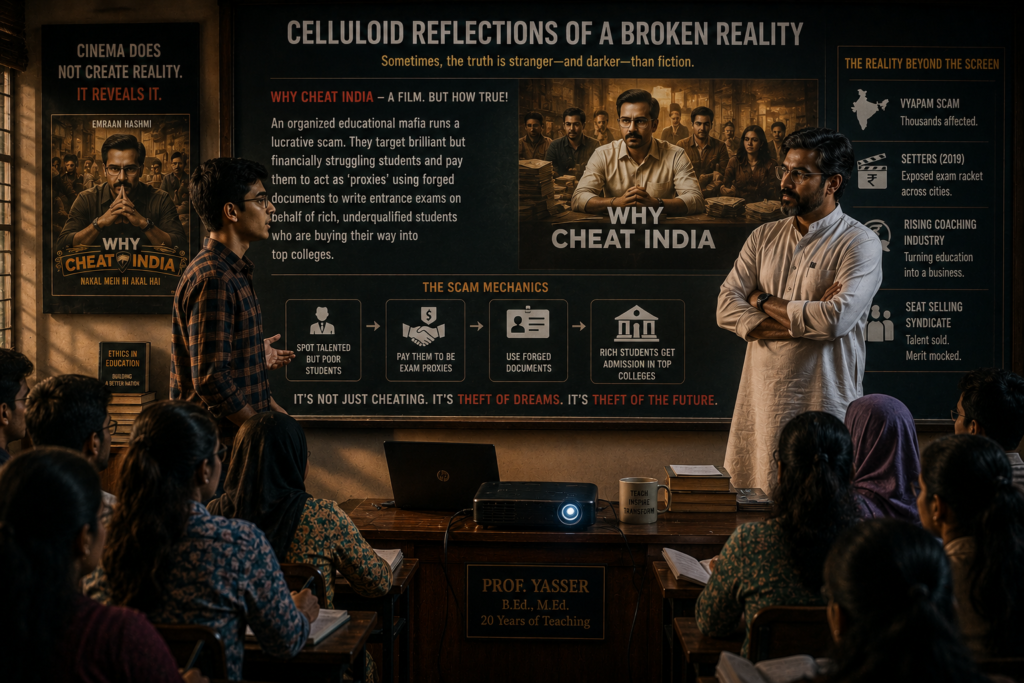
“And Setters showed the exact same modus operandi operating across cities like Mumbai, Delhi, Jaipur, and Varanasi,” Catherine added. “Academically weaker students are systematically replaced by brilliant ones inside the examination hall. It’s a calculated racket.”
Rehana, ever the pragmatist, leaned forward. “Sir, these are just movies. But what you are saying means this is actually happening in our cities, in our neighborhoods.”
“It is happening right now, Rehana,” Yasser said, his voice dropping to a near whisper. “I have a former student who now teaches in a college in Delhi. He told me about a wealthy father who walked into his office and offered him five lakh rupees to let his son use a proxy in the final exam. Five lakhs! When my friend refused, the father sneered and said, ‘Everyone does it. You are just being foolish.’ My friend looked him in the eye and said, ‘If everyone jumps off a cliff, will you ask your son to jump too?’ The father walked away furious, but that teacher saved one more honest seat in this country.”
The classroom was dead silent.

Education as a Business Cartel
“But this corruption is not limited to high-profile paper leaks or cinematic proxy syndicates,” Professor Yasser continued, his voice turning sharper as he moved away from the screen. “The rot runs directly into the everyday administration of our neighborhood schools. Education has transformed from a sacred duty into a blatant commercial business.”
He looked around the room, making eye contact with the future educators. “Look at what happens during admission time. It has become a marketplace where parents pay hefty, under-the-table ‘donations’ just to secure a seat for their son or daughter. The law says it’s illegal. The schools say it’s ‘development charges.’ And it gets worse. To guarantee entry into competitive streams in reputed colleges, affluent families are actively fabricating certificates to falsely prove they belong to the OBC, SC, or ST categories. They buy these documents to hijack quotas designed to level a historically brutal playing field, ultimately robbing a genuine, hardworking student from marginalized communities of their rightful place.”
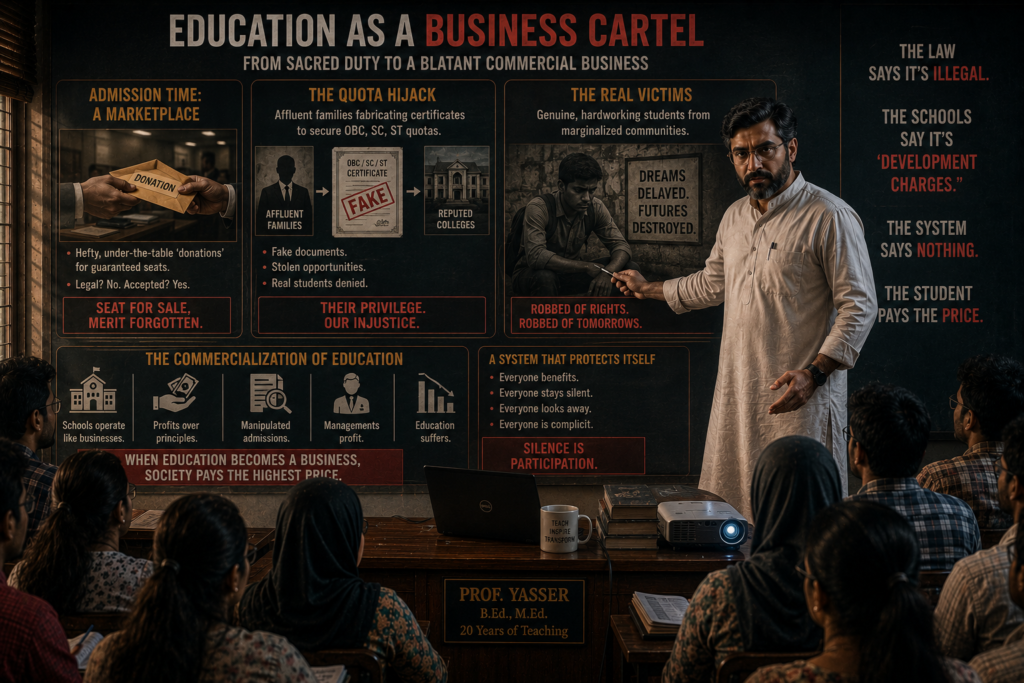
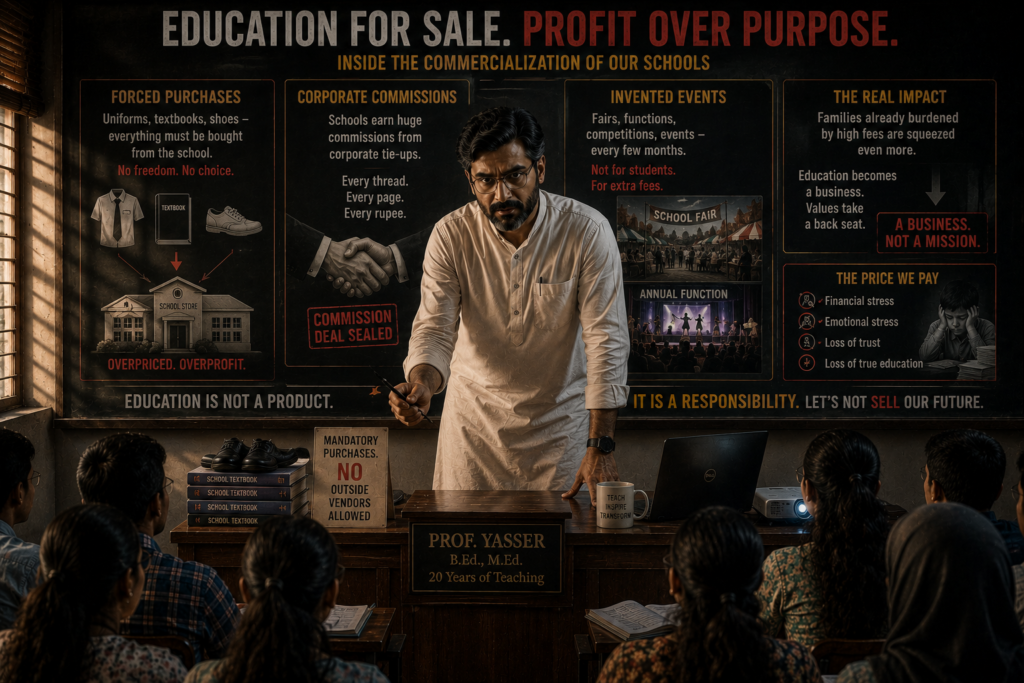
Professor Yasser slammed his hand lightly on his desk, the sound startling the front row. “Step inside these commercial schools, and you will see another dangerous phenomenon. Parents are legally mandated to purchase school uniforms, textbooks, and even shoes directly from the school itself. You are strictly forbidden from buying them from outside vendors. Why? Because the school management secures massive corporate commissions on every single thread and page. These items are sold at exorbitant, inflated prices to families already drowning under sky-high tuition fees. On top of that, these institutions constantly invent school fairs, functions, and mandatory events every few months, strictly to extract more cash from parents. In our nation, education has been transformed into a business.”
He paused, letting his breath steady as the heavy reality of his words settled over the classroom.
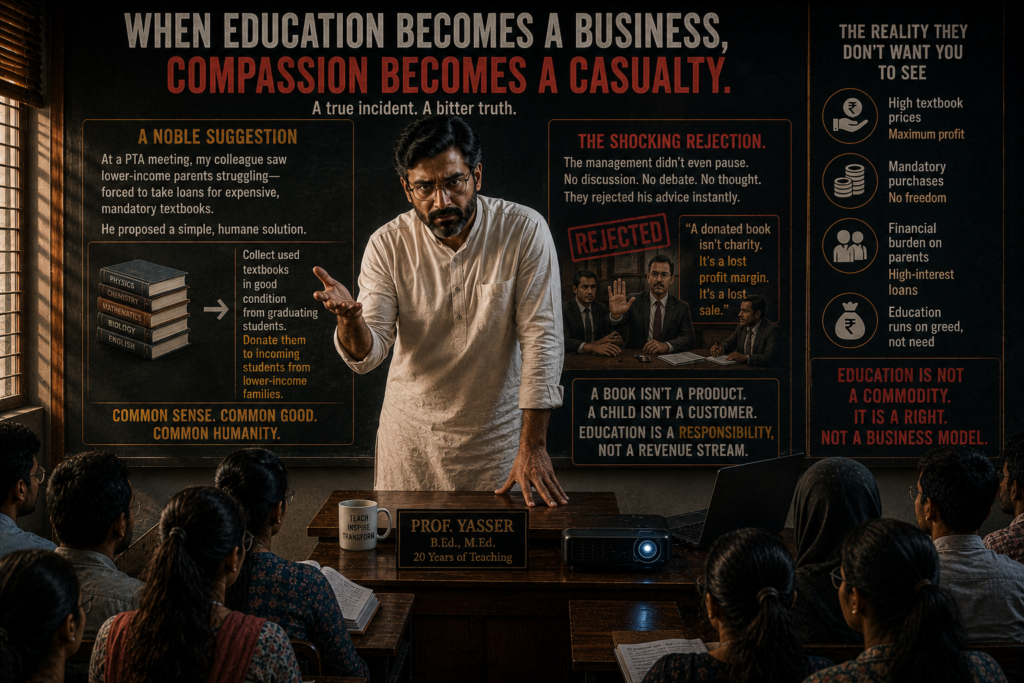
“To give you an idea of how ruthless this business model is,” Professor Yasser continued, his voice dropping from anger to a quiet, profound disappointment, “a close colleague of mine recently attended a Parents-Teachers Association meeting at one of these prominent corporate-style schools. Seeing how lower-income parents were being pushed to the brink, forced to take out high-interest loans just to afford the mandatory annual textbook bundle, he stood up and made a noble, common-sense proposal. He suggested that the school collect used textbooks in good condition from graduating students each year and donate them directly to the incoming children from lower-income backgrounds.”
Professor Yasser let out a bitter, hollow laugh. “Do you know what the school management did? They rejected his advice instantly, without a single second of open discussion, debate, or thought. To them, a donated book isn’t an act of charity or social relief; it’s a lost profit margin on a new sale. So, yes, look at it clearly—education has become nothing more than a commercial business nowadays.”
The Rise of the 58,000-Crore Empire
Before the weight of that thought could fully quiet the room, Zafar, who had been listening intently from the middle row, raised his hand to speak.
“Professor, if we are talking about commercial syndicates, I want to share a bizarre, almost comical incident that happened recently,” Zafar said, leaning forward. “It involves a NEET topper who created history by scoring a perfect 720 out of 720.“
Professor Yasser gestured with a welcoming wave of his hand. “Go on, Zafar. Let the class hear it.”
“Sir, the moment the results were declared and that student made history, an absolute marketing war exploded online,” Zafar explained, a wry smile on his face. “Within hours, multiple rival coaching centres released their own victory videos, promotional banners, and advertisements. Every single one of them claimed this exact same topper as their own exclusive classroom student, loudly insisting that their specific test series or their premium study material was the main ingredient behind his perfect score. It was a complete circus.”
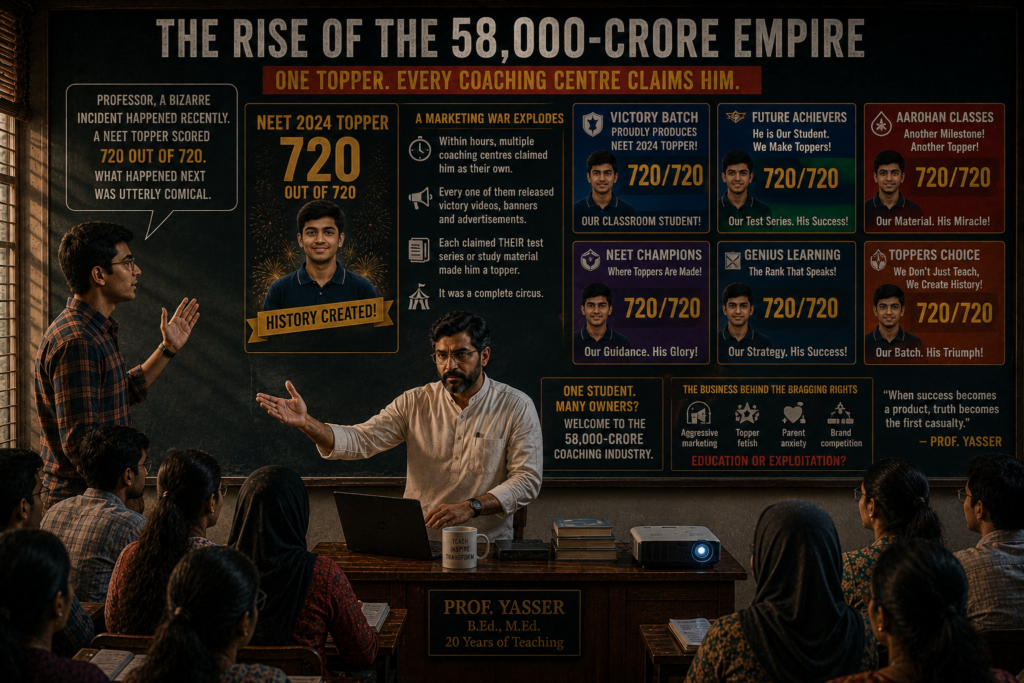
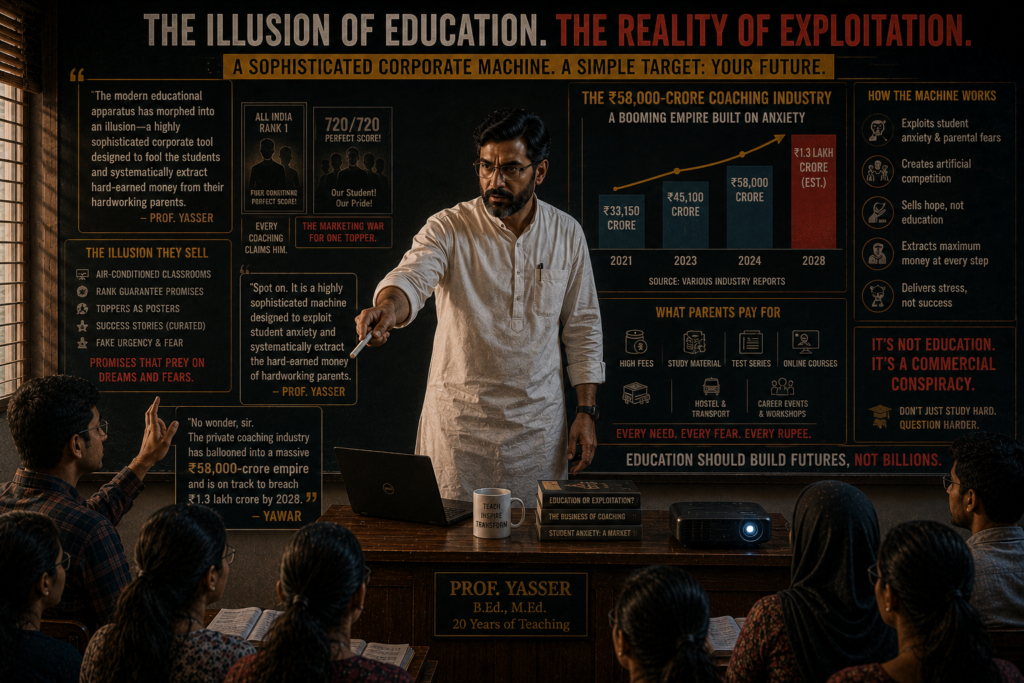
“Fascinating, isn’t it?” Professor Yasser said, a sharp, cynical edge cutting through his soft tone. “But beneath the absurdity lies a dark truth. You see, the modern educational apparatus has morphed into an illusion—a highly sophisticated corporate tool designed to fool the students and systematically extract hard-earned money from their hardworking parents.”
Yawar, who had remained entirely quiet near the back of the room until now, leaned forward, his voice heavy with realization. “No wonder, sir. When you see corporate profiteering on that scale, it makes perfect sense why the private coaching industry has ballooned into a massive ₹58,000-crore empire and is on track to breach ₹1.3 lakh crore by 2028.“
Professor Yasser nodded in agreement.
Professor Yasser pointed his piece of chalk directly at Yawar. “Spot on. It is a highly sophisticated machine designed to exploit student anxiety and systematically extract the hard-earned money of hardworking parents.”
The Shadow and the Titan: The DUMMY SCHOOL Epidemic
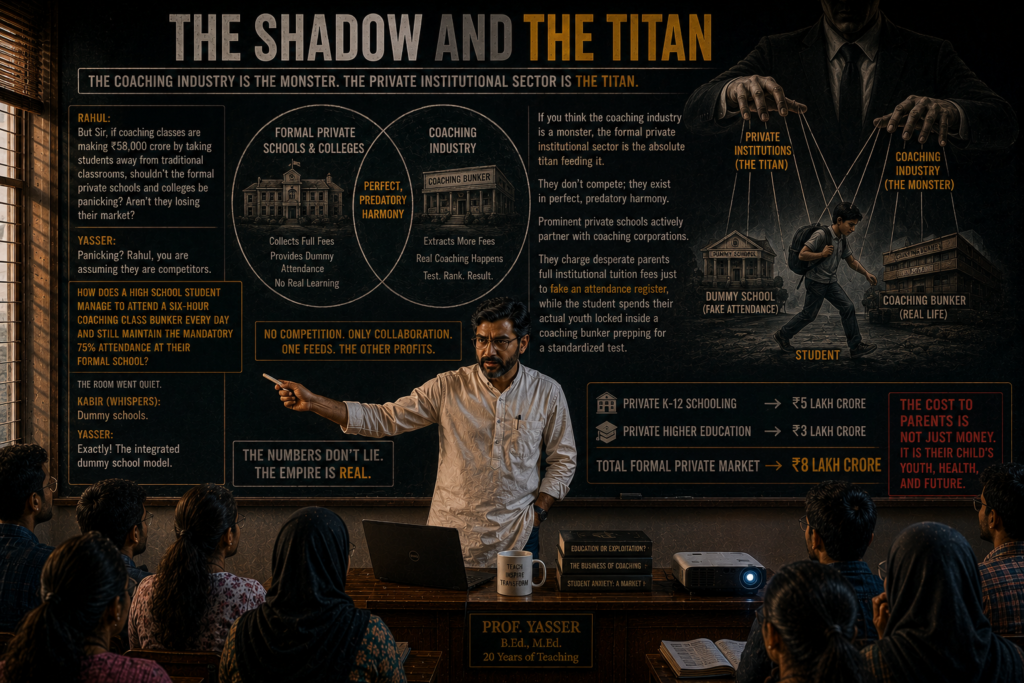
Rahul furrowed his brow, looking confused. “But Sir, if coaching classes are making ₹58,000 crore by taking students away from traditional classrooms, shouldn’t the formal private schools and colleges be panicking? Aren’t they losing their market?”
Professor Yasser chuckled, a dark, humorless sound. “Panicking? Rahul, you are assuming they are competitors. Let me ask you all a question: How does a high school student manage to attend a six-hour coaching class bunker every day and still maintain the mandatory 75% attendance at their formal school?”
The room went quiet. The students looked at each other.
“Dummy schools,” Kabir whispered from the side aisle.
“Exactly! The integrated dummy school model,” Professor Yasser said, sketching two overlapping circles on the blackboard. “If you think the coaching industry is a monster, the formal private institutional sector is the absolute titan feeding it. They don’t compete; they exist in perfect, predatory harmony. Prominent private schools actively partner with coaching corporations. They charge desperate parents full institutional tuition fees just to fake an attendance register, while the student spends their actual youth locked inside a coaching bunker prepping for a standardized test.”
He turned back to the board, adding rapid calculations to the chalk dust.
  [Private K-12 Schooling]  -->  ₹5 Lakh Crore
  [Private Higher Education] -->  ₹3 Lakh Crore
  ------------------------------------------------
  TOTAL FORMAL PRIVATE MARKET -->  ₹8 Lakh Crore
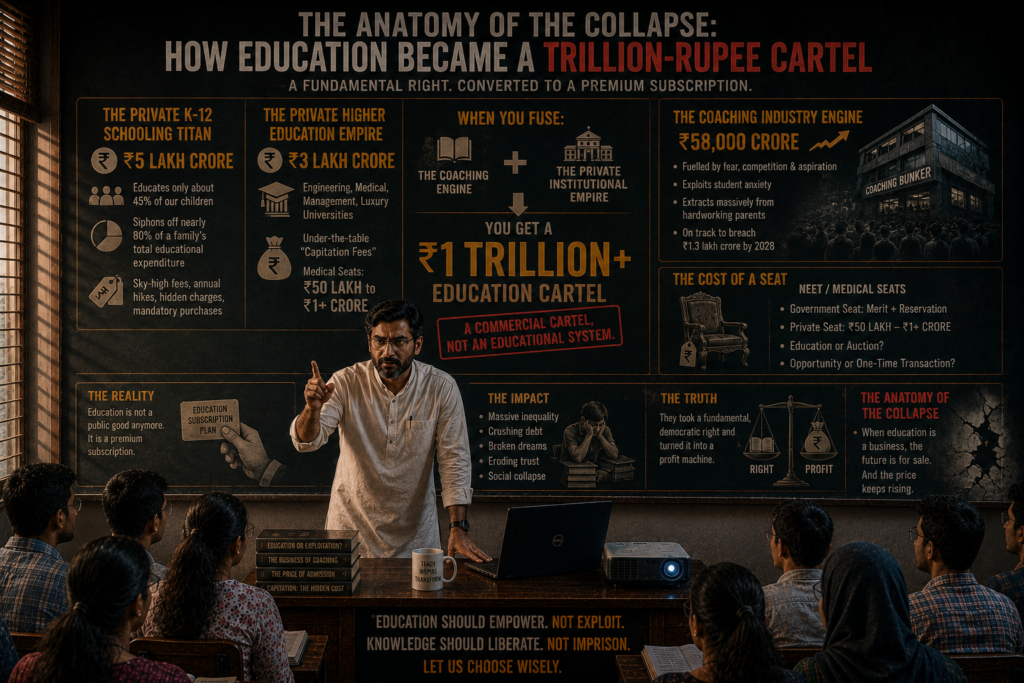
“Look at the sheer scale,” Professor Yasser continued, facing the class. “The private K-12 schooling market in India is a five-lakh-crore titan. Even though private schools educate only about 45% of our children, they siphon off nearly 80% of a family’s total educational expenditure. Add private higher education—the engineering, medical, and luxury universities—and you add another three lakh crore to the ledger. Think about the under-the-table ‘capitation fees’ for medical seats that command anywhere from fifty lakhs to over a crore.
When you fuse the coaching engine with this private institutional empire, what do you get?”
The class sat in stunned, breathless comprehension.
“You get a trillion-rupee commercial cartel,” Professor Yasser said softly, setting the chalk down. “They have taken a fundamental, democratic right and turned it into a premium subscription service—one that gets more ruthlessly expensive every single year. And that, my dear future educators, is the anatomy of the collapse.”
Force Politicians’ Children into Public Classrooms: The Only Way to Rebuild India’s Vanishing Government Schools
Moving towards the center of the room, Professor Yasser dusted the lingering chalk from his hands. “And that is exactly why I firmly believe that robust government schools and colleges are absolutely vital. They are our only real shield to counter this corporate takeover of the private educational sector.”
Sebastian raised his hand from the front row, shaking his head slightly. “Sir, that is much easier said than done. We all know the ground reality and the current state of our government schools. To my mind, the only way to save our public education system is to pass a simple rule: every single child of an elected politician, government official, or MLA must study only in government schools and colleges. Let’s see how drastically things improve then.”
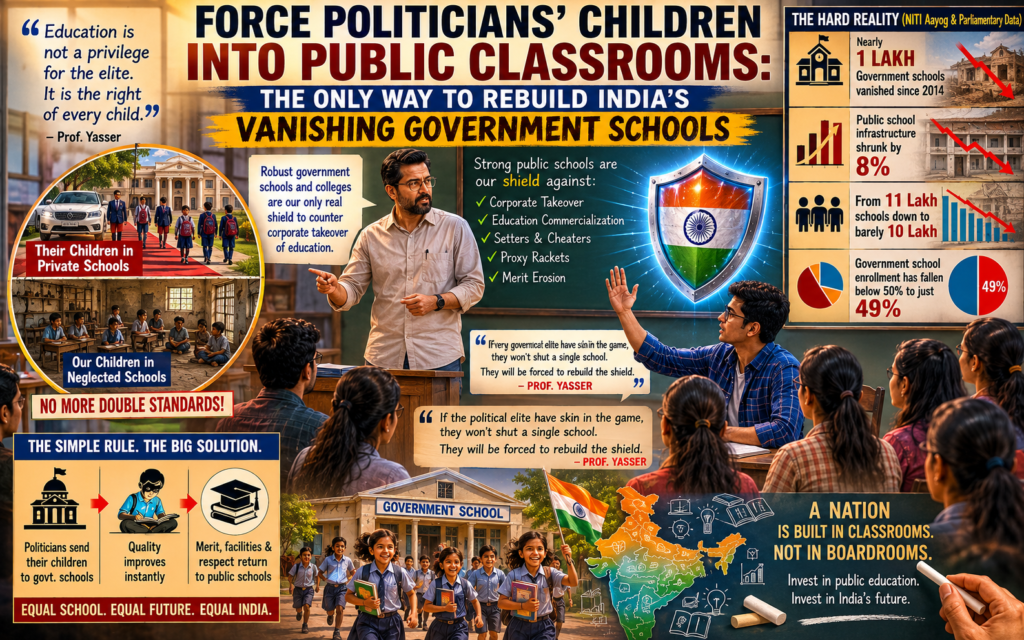
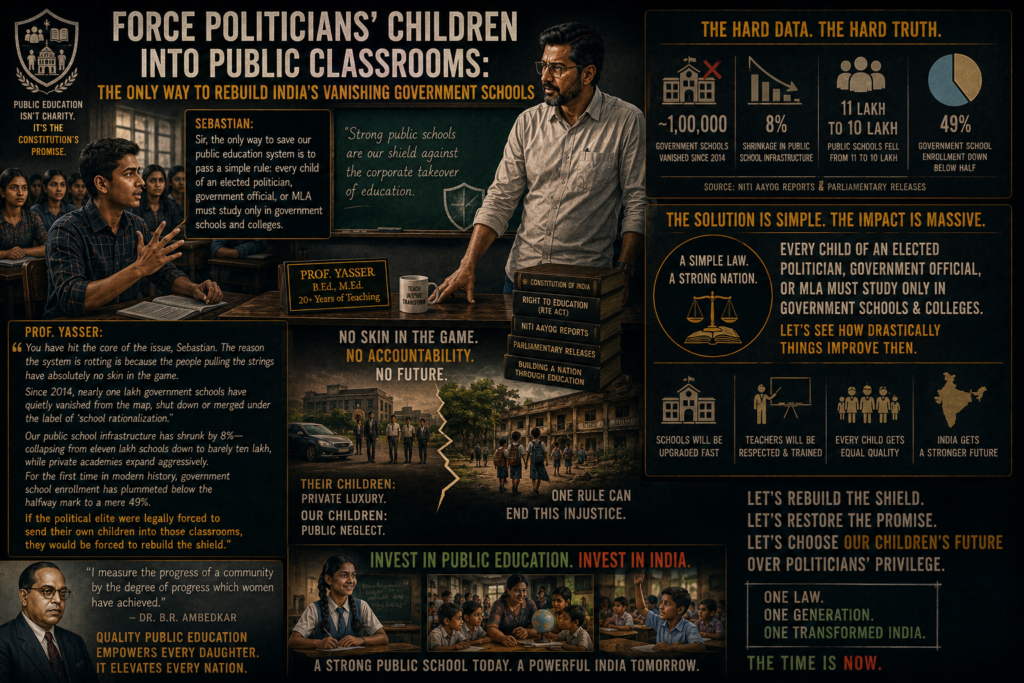
Professor Yasser’s expression turned deeply somber as he leaned back against the edge of his desk. “You have hit the absolute core of the issue, Sebastian. The reason the system is rotting is because the people pulling the strings have absolutely no skin in the game. In fact, if you look at the hard data from NITI Aayog and recent parliamentary releases, the state isn’t just neglecting public education—it is actively retreating from it. Since 2014, nearly one lakh government schools have quietly vanished from the map, shut down or merged under the sterile bureaucratic label of ‘school rationalization.’
Our public school infrastructure has literally shrunk by 8%, collapsing from eleven lakh schools down to barely ten lakh, while private academies aggressively expand to swallow up the territory. For the first time in modern history, government school enrollment has plummeted below the halfway mark to a mere 49%. So you are entirely right. If the political elite were legally forced to send their own flesh and blood into those systematically abandoned classrooms, the state wouldn’t be shutting down a single door. They would be forced to rebuild the shield.”
Can’t Spell the Calendar: The Catastrophic Collapse of Teacher Quality in Government Classrooms
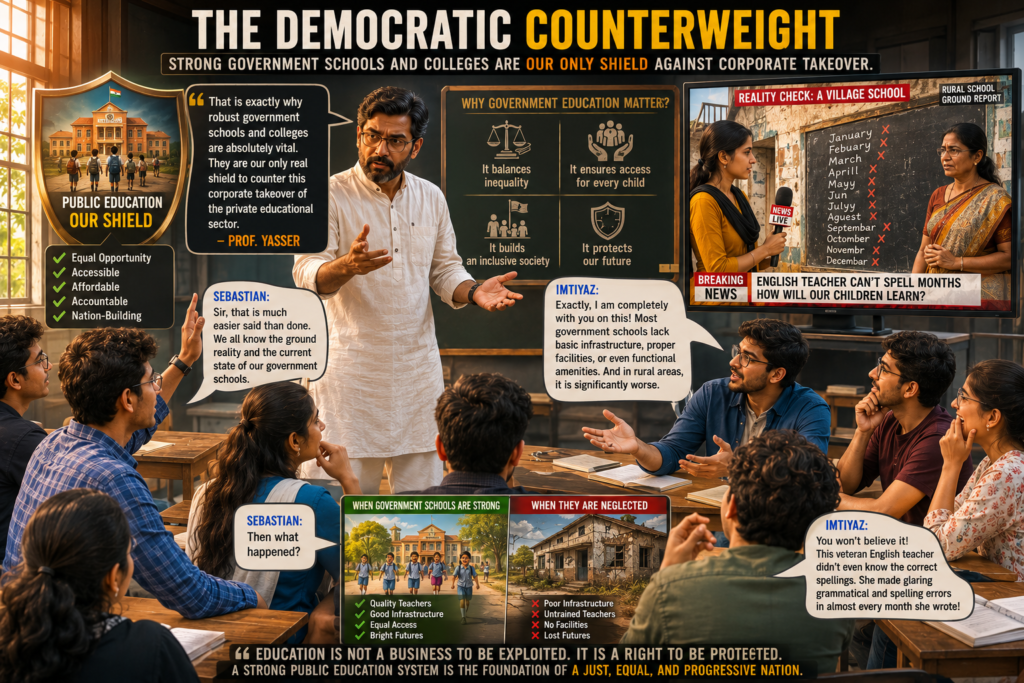
“Exactly, Sir. I am completely with Sebastian on this,” Imtiyaz chimed in, shifting in his seat. “Because when the state retreats, it doesn’t just close buildings—it leaves behind an absolute intellectual wasteland. Most of these surviving government schools completely lack basic infrastructure, proper facilities, or even functional amenities. But the human rot is what truly breaks you, especially in the rural belts.”
He paused, a volatile mix of amusement and genuine disbelief crossing his face. “I recently watched a ground report from a remote village school. The journalist walked into a classroom and asked the senior English teacher—a woman with a full decade of teaching experience on her service record—to simply write the twelve months of the year on a crumbling, water-damaged blackboard.”
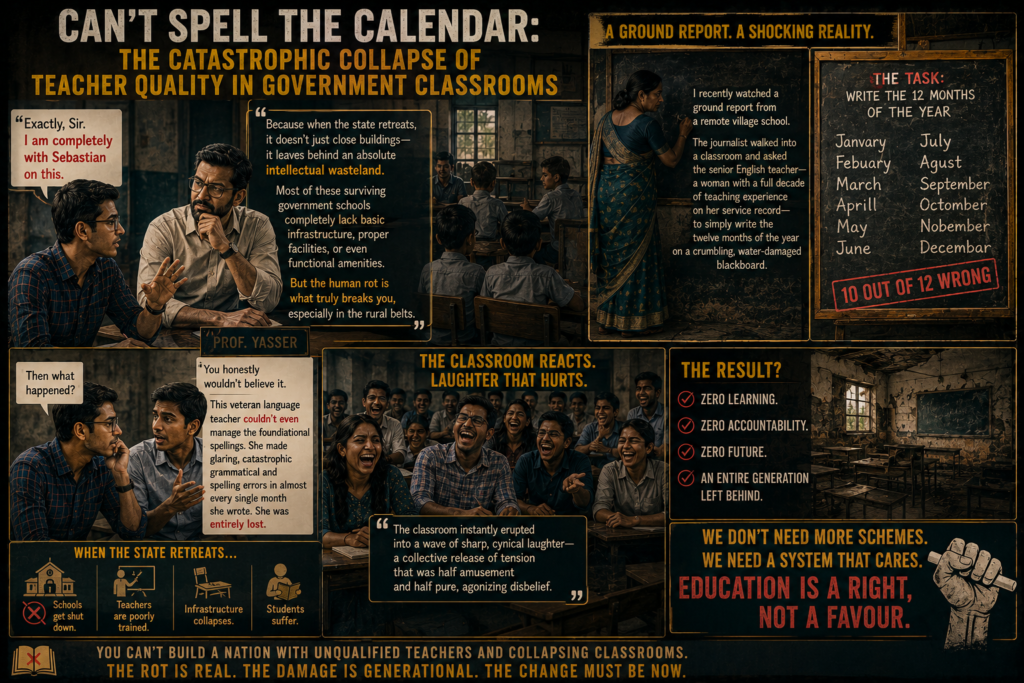
“Then what happened?” Sebastian asked, turning fully around in his seat to face him.
“You honestly wouldn’t believe it,” Imtiyaz said, throwing his hands up in frustration. “This veteran language teacher couldn’t even manage the foundational spellings. She made glaring, catastrophic grammatical and spelling errors in almost every single month she wrote. She was entirely lost.”
The classroom instantly erupted into a wave of sharp, cynical laughter—a collective release of tension that was half amusement and half pure, agonizing disbelief.
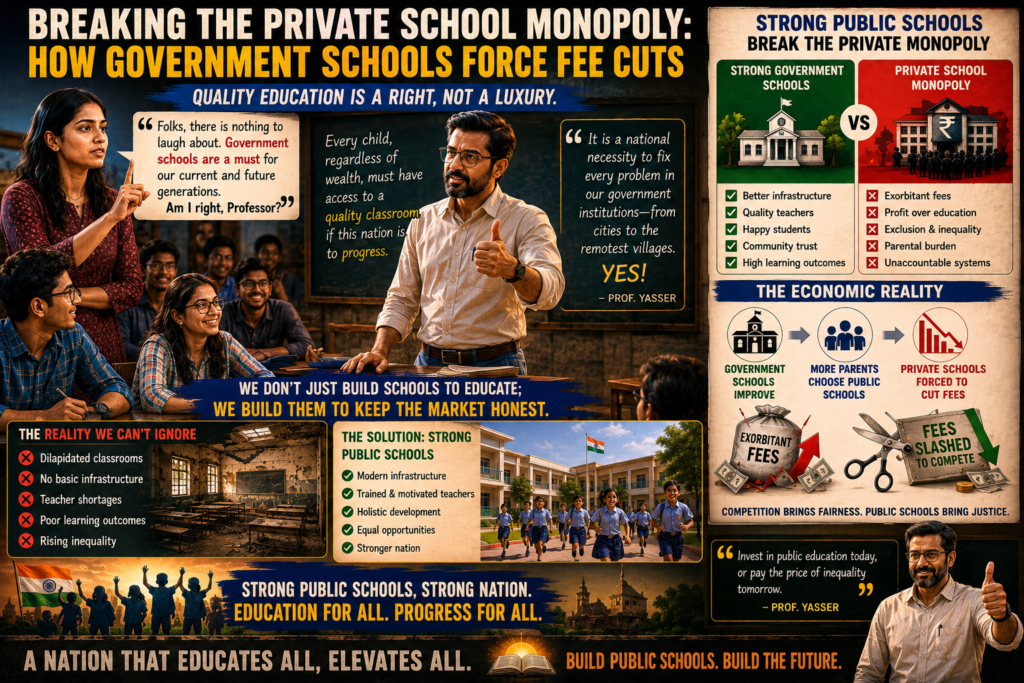
Breaking the Private School Monopoly: How Government Schools Force Fee Cuts
Priya, however, remained completely unamused. She sat up straight, her expression hardening as she cut through the amusement. “Folks, there is absolutely nothing to laugh about when it comes to the pathetic condition of our public institutions. Government schools are a non-negotiable must for our current and future generations. If we let them fail, quality education will permanently become an exclusive privilege for rich kids and the affluent class. Am I right, Professor?”
“Yes!” Professor Yasser said, his voice ringing out with deep conviction. “I am entirely with you on this, Priya. It is an absolute national necessity to systematically fix every single problem plaguing our government institutions, from urban centers to the remotest rural pockets. Every single child, regardless of their family’s wealth, must have access to a quality classroom if this nation is to progress.”
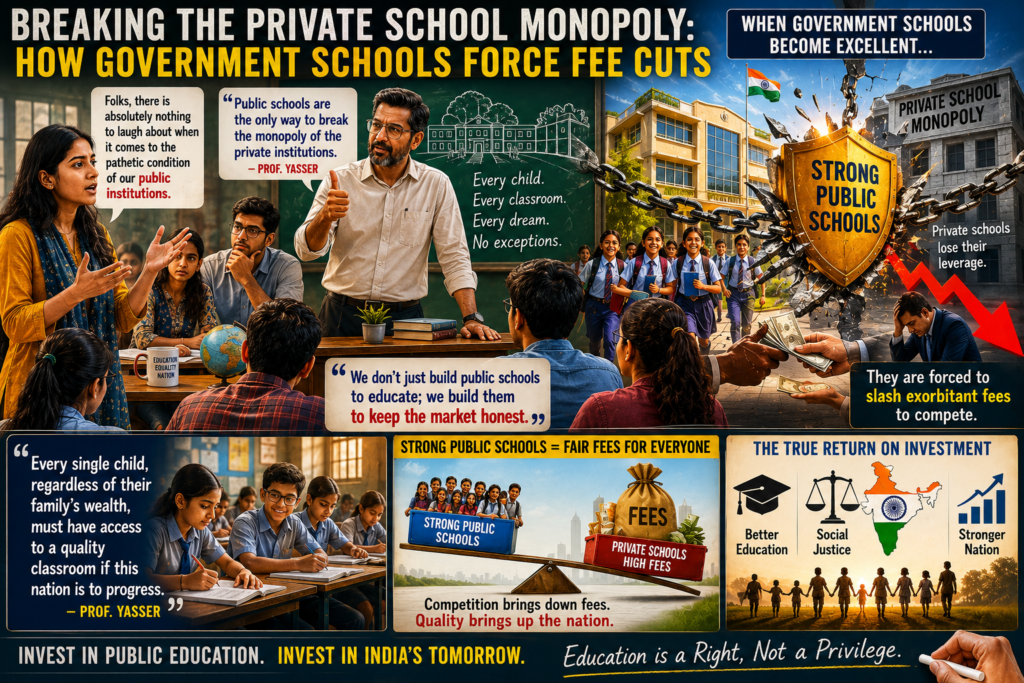
He leaned against the front desk, looking intently at his future teachers. “And there is an economic reality to this as well. Public schools are the only way to break the monopoly of the private institutions. The moment government schools and colleges upgrade their infrastructure and elevate their quality of teaching, the private sector loses its leverage. They will be forced to drastically slash their exorbitant annual fees just to compete. We don’t just build public schools to educate; we build them to keep the market honest.”
Professor Yasser looked at Priya, then out at the entire room, and gave them a resolute thumbs up.
The Theft of Destiny: Stolen Seats, Stolen Dreams
Professor Yasser walked back to the blackboard, wiped it clean with a damp cloth, and wrote in stark white chalk:
“QUOTA FRAUD: THE SILENT MURDER OF MERIT.”
He turned to the class, his face grim. “Now, let us talk about the most despicable crime of all—stealing the rightful place of the underprivileged.”
He paced slowly, his footsteps echoing. “Our nation has reservation policies. Quotas for the economically weaker sections, for differently-abled individuals, for scheduled castes and tribes. Why? To give a fair chance to those who have been historically marginalized, to those brilliant students who study under the dim light of a single bulb in a village, who walk miles to school, who fight poverty and prejudice with sheer grit.”
He stopped and looked directly at the class.
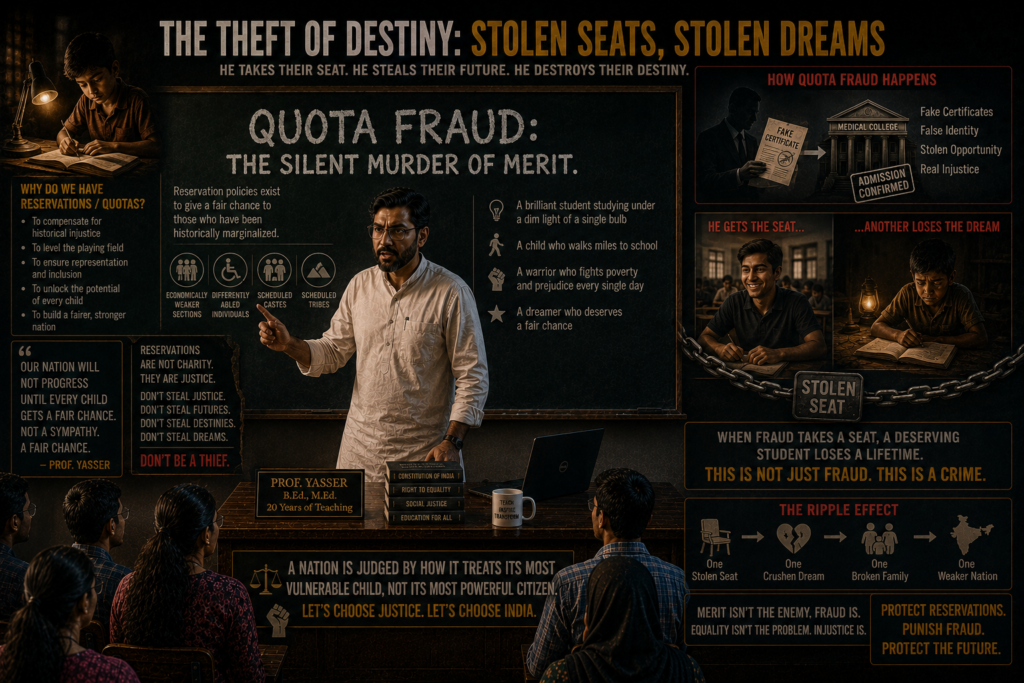
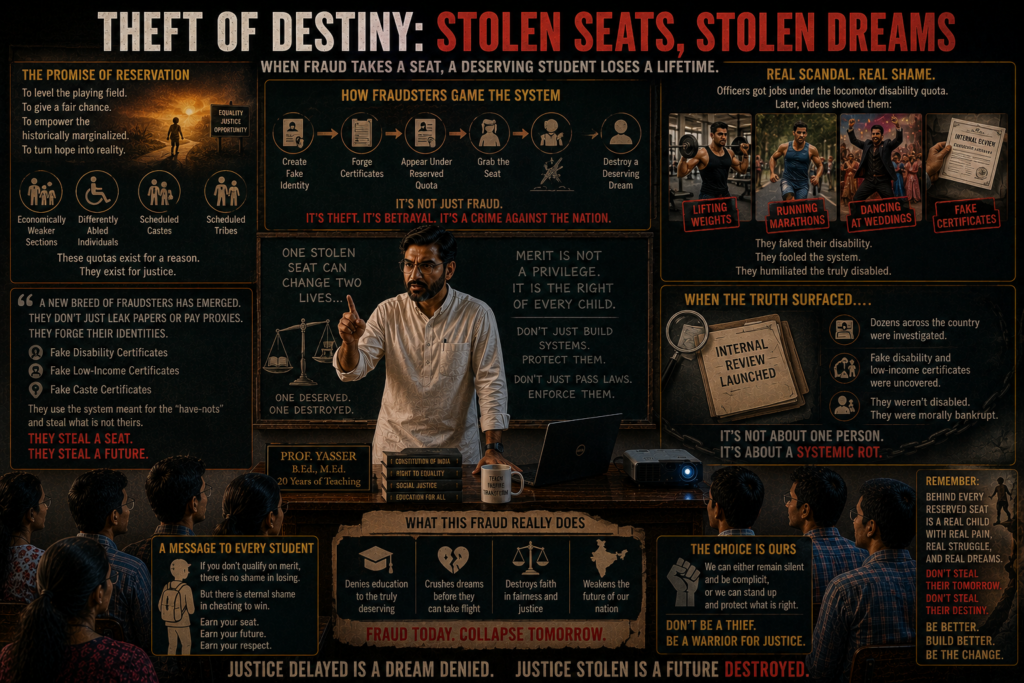
“But what happens? A new breed of fraudsters has emerged. They don’t just leak papers or pay proxies. They forge their identities. They obtain fake disability certificates, fake low-income certificates, fake caste certificates. They sit for the exam under a reserved quota—meant for the ‘have-nots’—and they steal that seat. They steal the future of a genuinely deserving student.”
Divya’s jaw tightened. “Sir, I read about this. There was this huge scandal where officers got into services under the locomotor disability quota, but later videos surfaced of them lifting heavy weights, running marathons, and dancing at weddings. They had faked their physical restrictions!”
Professor Yasser nodded, holding up a hand. “You are right, Divya, but we must be careful here. We will not name individuals, because this is not about one person. This is about a systemic rot. When such a scandal broke out, what happened? A massive internal review was launched. Dozens of people across the country were investigated for fabricating disability and low-income certificates just to slip past competitive quotas. They weren’t disabled; they were morally bankrupt.”
Rehana spoke up, her voice trembling with emotion. “Sir, my cousin is from a small village in Uttar Pradesh. He has a mild physical impairment in his leg, but he studied his entire life hoping to get a government job through the disability quota. He worked day and night. He scored brilliantly in the written exam. But he didn’t get the final selection. We always wondered if someone else took his place unfairly. Now I understand—someone with more money, more connections, might have bought a fake certificate to push him out.”
“Rehana, your cousin is the invisible casualty of this war,” Professor Yasser said softly, walking over to her row. “These fraudsters don’t just cheat the system—they assassinate the dreams of millions of deserving, underprivileged students. They take the bread from the mouths of the poor and wrap it in golden lies. This is worse than a paper leak. This is the murder of social justice.”

The Five-Lakh Cabin
The classroom fell into a thick, heavy silence. Professor Yasser looked out at his fifty students, his expression softening into something deeply introspective.
“I want to share something personal with you,” Yasser said, his voice dropping an octave. “Before I received my appointment here at Anjuman College in Vashi, I applied for a vacancy at a local government-aided school. I gave my demo lecture; the students were wonderfully engaged, and the principal seemed thoroughly pleased with my methodology.”
He stepped closer to the front row, his hands resting on the edge of the podium. “But when I met him privately in his office afterward, expecting an honest offer letter, he quietly closed the door. He sat across from his grand desk, looked me dead in the eye, and calmly demanded a bribe of five lakh rupees under the table to secure the teaching position. When he saw the utter shock on my face, he just laughed. He said, ‘Yasser, the state-regulated salary scale for a teacher in a government-aided institution is very high. Don’t look at it as a loss—you will easily recover this initial investment within 18 to 20 months. It’s just the cost of doing business.’“
Professor Yasser looked down at his chalk-dusted hands, turning them over slowly. “He was telling me that to teach children integrity, I first had to participate in a financial crime. He was telling me that my conscience had a retail price tag. I told the principal I would get in touch, walked out of his cabin, and never looked back.”
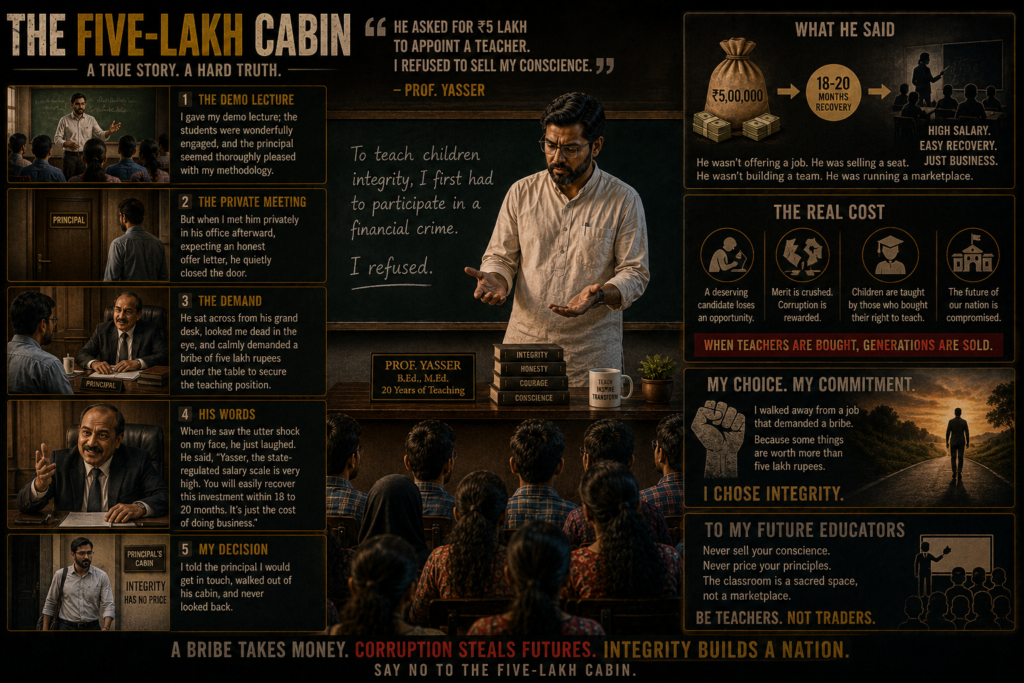
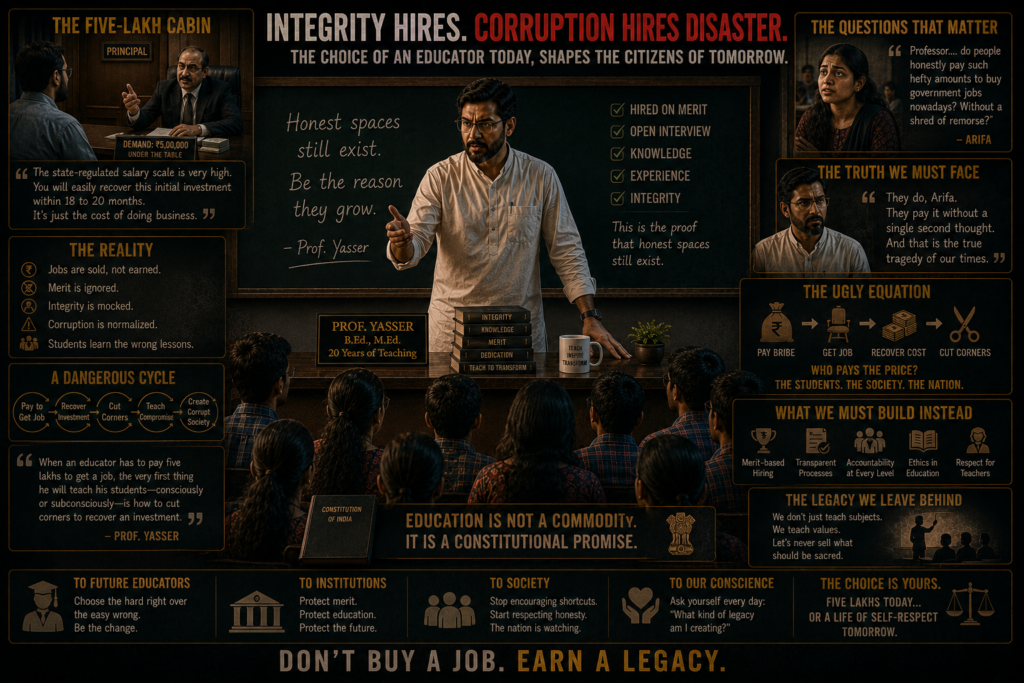
He gestured to the classroom around him. “Instead, I brought my credentials here to Anjuman B.Ed College, where I was hired strictly on the basis of my merit, my open interview, and my knowledge. Me standing right here in front of this blackboard today is the ultimate proof that honest spaces still exist. But that cabin changed me. Because if an educator has to pay five lakhs to get a job, the very first thing he will teach his students—consciously or subconsciously—is how to cut corners to recover an investment.”
Arifa leaned forward, her eyes wide with a mixture of disbelief and disillusionment. “Professor… do people honestly pay such hefty amounts to buy government jobs nowadays? Without a shred of remorse?“
“They do, Arifa,” Professor Yasser met her gaze, his voice heavy with a profound sadness. “They pay it without a single second thought. And that is the true tragedy of our times. When a sacred public duty is reduced to a consumer commodity you can simply purchase under the table, it shows you exactly how deeply the rot has set into the very bones of our educational system.”
The Chalk vs. The Syndicate: A Teacher’s Real Weapon
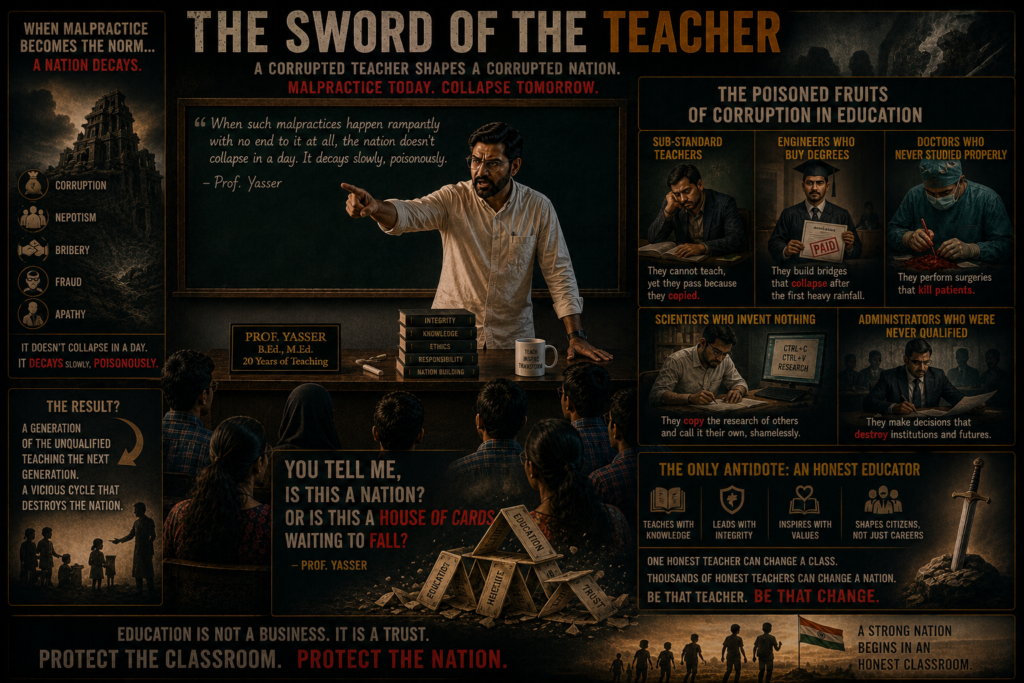
He returned to the center of the classroom, his voice rising with passion. “When such malpractices happen rampantly with no end to it at all, the nation doesn’t collapse in a day. It decays slowly, poisonously. We get sub-standard teachers who cannot teach, yet they pass because they copied. They go into schools and ruin the lives of thousands of students. We get engineers who buy their degrees—they build bridges that collapse after the first heavy rainfall. We get doctors who never studied properly—they perform surgeries that kill patients. We get scientists who invent nothing but copy the research of others and call it their own, shamelessly.”
He slammed his chalk on the table. “You tell me, is this a nation? Or is this a house of cards waiting to fall?”
Zainab looked up, her expression a mix of frustration and helplessness. “But sir, we are just fifty B.Ed. students in Vashi. How do we fight an educational mafia, proxy syndicates, and institutionalized forgery?”
Professor Yasser smiled—a deep, reassuring expression that broke the heavy tension in the room. He walked over to his desk and picked up a piece of chalk, turning it over in his hand.
“It starts with the small things in your own lives,” Professor Yasser said, leaning forward, his eyes locking with theirs. “You refuse to bend the rules for a relative who asks you to tweak an internal assignment score. Then, when you graduate and step into your own schools, you look a corrupt administrator in the eye and say a flat no to a falsified attendance register designed to siphon off state grants. You don’t stay silent when you see a colleague turning a blind eye to a student passing answer keys under a desk.”
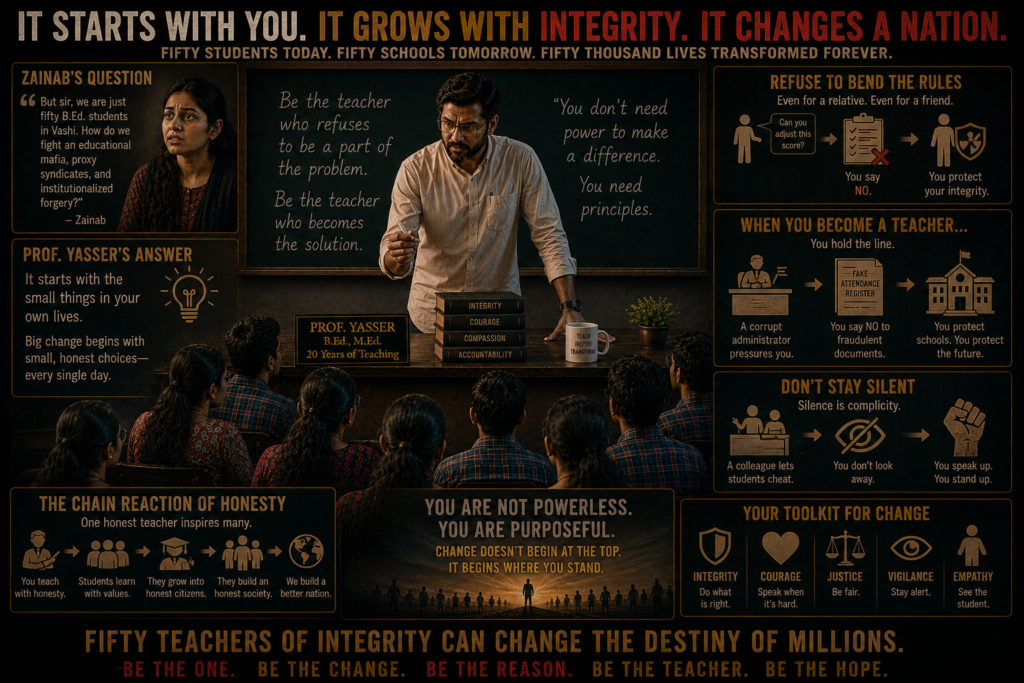
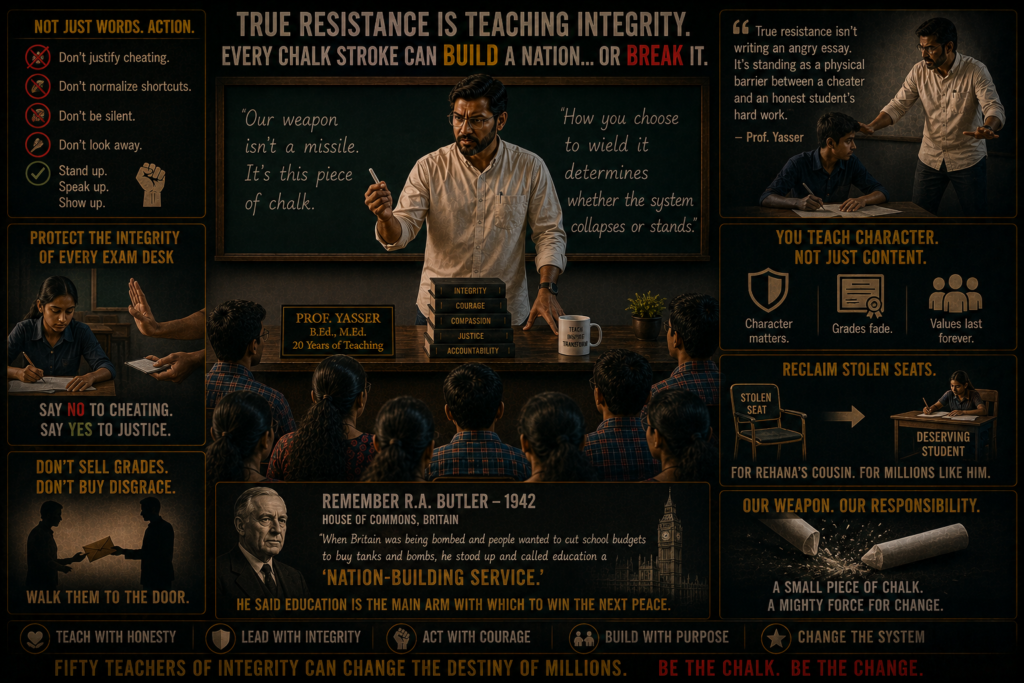
He tapped the chalk against his palm. “True resistance isn’t writing an angry essay, Zainab; it’s standing as a physical barrier between a cheater and an honest student’s hard work. You teach your students that character matters infinitely more than a forged percentage on a sheet of paper. When a wealthy parent walks into your staffroom and hints at a ‘donation’ to alter a grade, you walk them to the door. Every time you protect the integrity of a single exam desk, you are actively dismantling a proxy syndicate. You are reclaiming a stolen seat for a student like Rehana’s cousin.”
He paced down the center aisle, looking at the faces on either side. “Remember what R.A. Butler told the House of Commons in 1942, when Britain was being bombed during the Second World War and people wanted to cut school budgets to buy tanks and bombs? He stood up and called education a ‘nation-building service.’ He said education is the main arm with which to win the next peace. Our weapon isn’t a missile, class. It’s this piece of chalk. And how you choose to wield it determines whether the system collapses or stands.”
The Bell That Changed Everything
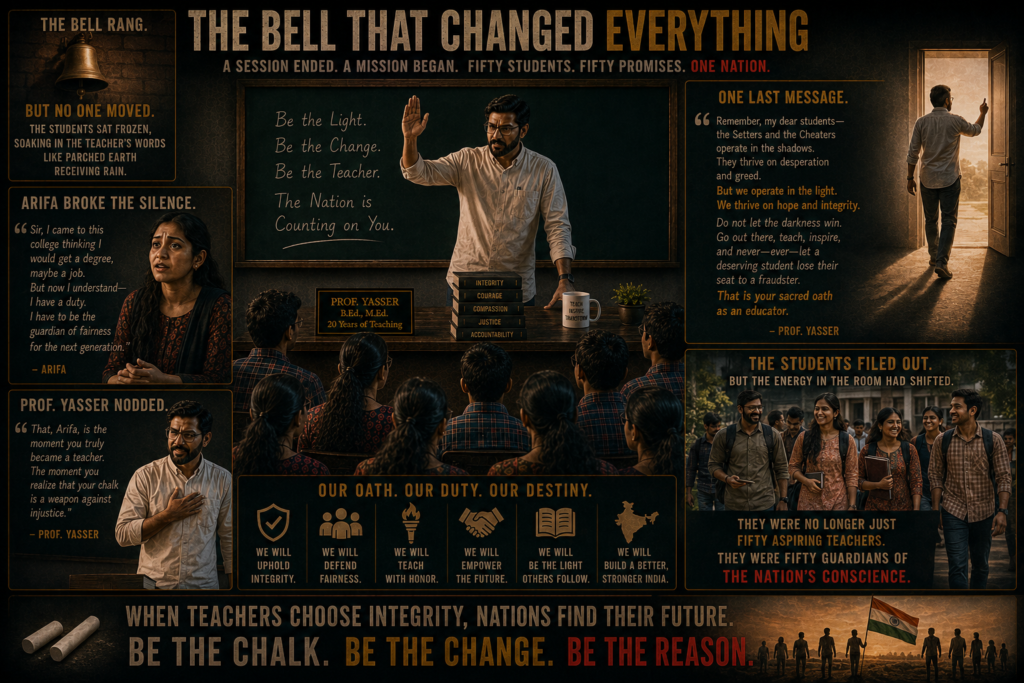
The college bell rang, signaling the end of the session. But no one moved. The students sat frozen, soaking in the teacher’s words like parched earth receiving rain.
Arifa broke the silence. “Sir, I came to this college thinking I would get a degree, maybe a job. But now I understand—I have a duty. I have to be the guardian of fairness for the next generation.”
Professor Yasser nodded, his eyes glistening. “That, Arifa, is the moment you truly became a teacher. The moment you realize that your chalk is a weapon against injustice.”
As the students gathered their things, Professor Yasser called out one last time. “Remember, my dear students—the Setters and the Cheaters operate in the shadows. They thrive on desperation and greed. But we operate in the light. We thrive on hope and integrity. Do not let the darkness win. Go out there, teach, inspire, and never—ever—let a deserving student lose their seat to a fraudster. That is your sacred oath as an educator.”
The students filed out, but the energy in the room had shifted. They were no longer just fifty aspiring teachers. They were fifty guardians of the nation’s conscience.
Epilogue: The Ripples of Vashi
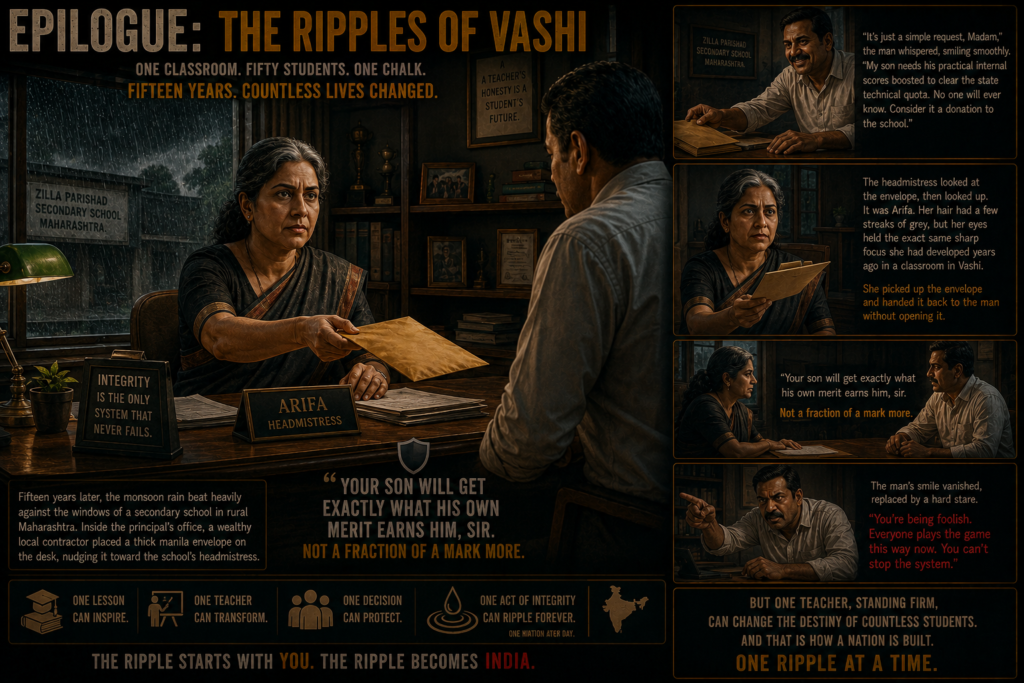
Fifteen years later, the monsoon rain beat heavily against the windows of a secondary school in rural Maharashtra. Inside the principal’s office, a wealthy local contractor placed a thick manila envelope on the desk, nudging it toward the school’s headmistress.
“It’s just a simple request, Madam,” the man whispered, smiling smoothly. “My son needs his practical internal scores boosted to clear the state technical quota. No one will ever know. Consider it a donation to the school.”
The headmistress looked at the envelope, then looked up. It was Arifa. Her hair had a few streaks of grey, but her eyes held the exact same sharp focus she had developed years ago in a classroom in Vashi.
She picked up the envelope and handed it back to the man without opening it. “Your son will get exactly what his own merit earns him, sir. Not a fraction of a mark more.”
The man’s smile vanished, replaced by a hard stare. “You’re being foolish. Everyone plays the game this way now. You can’t stop the system.”
Arifa stood up, walking over to the classroom map on her wall. “I had a professor once, Mr. Yasser, who taught me that destroying a nation doesn’t require bombs—it just requires letting fraud take the place of merit. I can’t change the entire system today, but inside the walls of this school, the rules apply equally to everyone. Your son will have to study.”
As the contractor walked out furious, slamming the door behind him, Arifa looked out into the rain-drenched courtyard. A group of children were walking toward the library, their textbooks pulled close to their chests to keep them dry. Their dreams were safe, shielded by a line drawn in white chalk years ago at Anjuman-I-Islam’s Akbar Peerbhoy College of Education—a chain of integrity that remained completely unbroken.
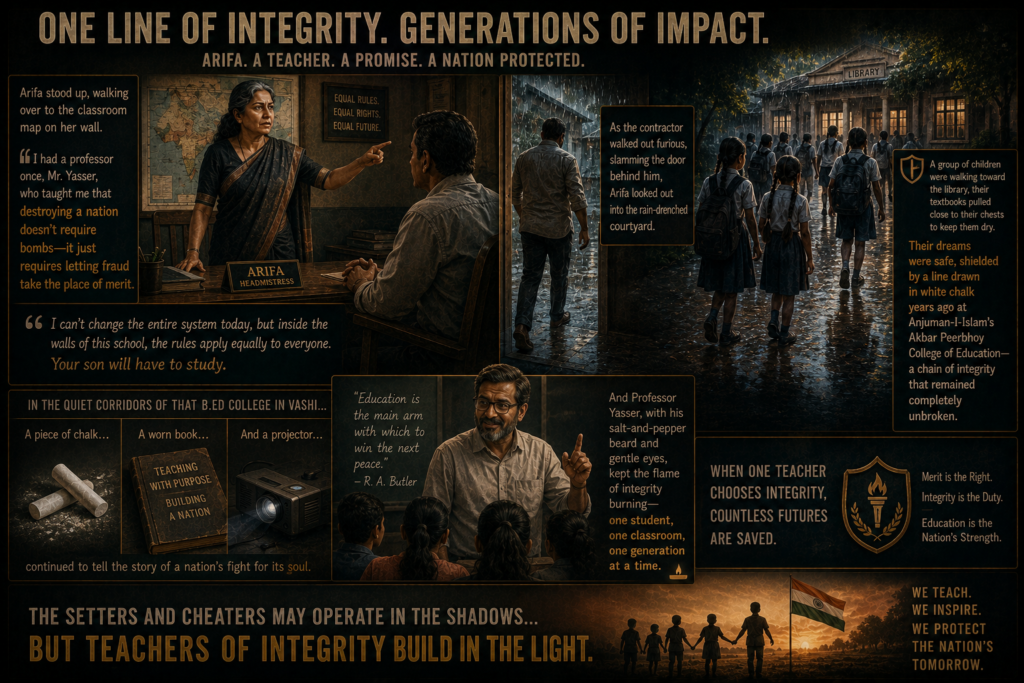
In the quiet corridors of that B.Ed college in Vashi, a piece of chalk, a worn book, and a projector continued to tell the story of a nation’s fight for its soul. And Professor Yasser, with his salt-and-pepper beard and gentle eyes, kept the flame of integrity burning—one student, one classroom, one generation at a time.
Read the companion literary story:
- 14 Best Panchatantra ki Kahaniya-पंचतंत्र की सम्पूर्ण कहानियाँ
- 15 Best Children Stories in English from Panchatantra 2.0
- 16 amazing Aesop ki Kahaniya-ईसप की दंतकथाएँ
- 17 Best Aesop's Fables with moral lessons for children
- Arabian Nights
- Author's Best Written Stories in English
- Author's Best Written Stories हिंदी में-लेखक की सर्वश्रेष्ठ कहानियाँ
- Baital Pachisi बैताल पचीसी हिंदी में
- Bedtime Stories for All
- Hindi Love Stories-प्रेम और रोमांस की कहानियों
- Love and Romance
- Professor Yasser Ki Class: दास्तान-ए-यासिर
- Professor Yasser's Lectures
- Vikram and Betal series: Riddle Solving Stories
You can join my WhatsApp Channel by clicking the link here


